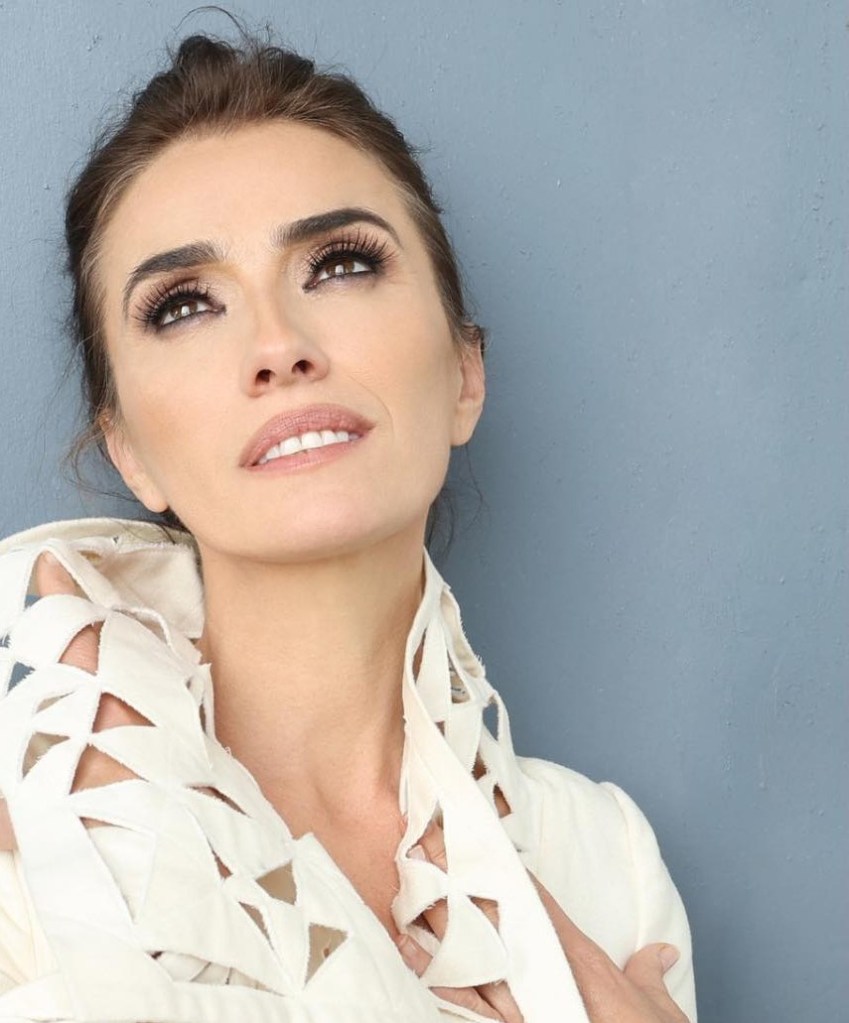
Above: Ermonela Jaho
~ Author: Oberon
Saturday May 16th, 2026 matinee – I spent the afternoon at my Met score desk for my third TRAVIATA of the season. Earlier this Spring, Lisette Oropesa and Rosa Feola gave impressive performances as Violetta; this afternoon was my second time to hear Ermonela Jaho in the role. Ms. Jaho is a unique singer, one who seems to live each role she takes on. Today, her cast-mates were Kang Wang as Alfredo and Lucas Meachem as Germont. Marco Armiliato, who had conducted Ms. Feola’s performance so beautifully, was back on the podium.
TRAVIATA and I go way back…to 1962, when I saw it for the first time at the Cincinnati Zoo Opera. The legendary Licia Albanese was my first Violetta; on that day, she was singing the role for the 100th time. About 40 years later, I met Mme. Albanese while I was working at Tower Records. I reminded her of her Cincinnati Violetta; she spoke of singing at The Zoo, and made some charming animal noises.
On November 12th, 1966, I saw TRAVIATA twice on the same day. In the afternoon, Patricia Brooks sang Violetta (opposite Placido Domingo) at the New York City Opera, and in the evening, Virginia Zeani made her belated Met debut in the role.
Patricia Brooks has always been the ideal Violetta for me. Many sopranos have had the vocal and histrionic gifts to make a memorable impression, but Patty lived the role. That she etched in a high-C trill in “Sempre libera” and capped the aria off with a delirious high E-flat gave the Brooks Violetta added vocal distinction, but it was her fragility of both body and voice that took her to the soul of Alphonsine Plessis, the courtesan on whom the character of Violetta is based. Mlle. Plessis died of tuberculosis at the tender age of 23; her grave, in the Cimetière de Montmartre, has long been a place of pilgrimage for romantics from around the globe.
This afternoon, the Albanian soprano Ermonela Jaho gave us a Violetta that had the same uncanny ‘reality’ about it that Ms. Brooks always found in the role. Their voices are very different, but at the end, both left us with a feeling of a very personal bereavement.
Today’s was one of the smallest Met audiences I’ve ever seen. It was sad that more people were not there to experience this compelling performance, which commenced with the haunting prelude – the opening hushed bars of which evoke mortality, and the melody of Violetta’s poignant declaration of love, “Amami, Alfredo…” reminds us of the story behind the parting of Violetta and Alfredo. Marco Armiliato, who can sometimes get carried away with volume and speed, this afternoon favored a cushioning sound for the unusual Jaho timbre.
As is her wont, it took the soprano a few bars to clear the voice of a flutter, but by the Brindisi she was going full-tilt, joining tenor Kang Wang – his voice melodious and with a nice mix of power and nuance – on a bright top B-flat. Ms. Jaho’s coughing fit, the first sign of Violetta’s eventual fate, was so realistic…the phrases as she sent her guests into the ballroom were breathless and agonizing. Alfredo comes to comfort her, revealing – in one of my favorite lines in the opera – that he has been in love with her for a year before now meeting her at last. His ardent “Un di felice” is met with hints of rubato as the soprano responds…their final harmonizing is sweet indeed, as is their tender parting.
In her hushed musings on the effect Alfredo has had on her, Ms. Jaho draws us in. Her “Ah! fors e lui...” is ravishing, sung with such poetic delicacy. The aria’s ending is awesomely sustained by the soprano’s uncanny breath control. The Jaho “Sempre libera...” is not a showpiece but a reflection – voiced with a sense of quiet desperation – of Violetta’s need to be free. The florid passages are nimbly tossed-off, and her top-Cs rang clear and true. Kang Wang’s persuasive offstage serenade could melt any heart. Ms. Jaho resumes her hymn to freedom, singing even more subtly than before.
Kang Wang opened the second act with his aria describing his bliss in leading a domestic life with the woman of his dreams. The tenor’s sustained vocal line, and his pensive musings of how heavenly it is to be in love, are lyrically compelling. After a polished ending, and learning of Violetta’s financial troubles, Kang Wang tops off the fiery cabaletta “O mio rimorso...” with élan, concluding with a ringing top-C.
Now, in the great scene between Violetta and Alfredo’s father, we are at the heart of the opera. Lucas Meachem, a towering stage presence with a voice to match, at first bluntly treats Violetta like the whore he thinks she is. Ms. Jaho replies with exquisite grace in such beautiful lines as “Era felice troppo...”, and then Germont explains his need for Violetta’s compliance in order to save his daughter’s impending marriage. Jaho’s horrified “…giammai!” and desperate “…preferiro morire…” are followed by her hushed “Gran dio!” as the facts of the situation are revealed. Mr. Meachem’s magnificent timbre makes a feast out of Verdi’s music, his extended top note at “…dio che inspira, o giovine…” is marvelous.
We are now at the turning point of the opera: Violetta’s capitulation with Jaho’s extraordinarily touching “Dite alla giovine…” is a surrender that cannot be undone. The two voices continue to magically engross us with their mixture of subtlety and power. Their final note is remarkably sustained, their parting heralding the tragedy to come.
Maestro Armiliato somehow bungled the “Amami, Alfredo!“, but order is restored and Mr. Meachem delivers a sustained voicing of the recit that leads to his “Di Provenza...”, glorious Verdi baritone singing that puts him in a class with his “great American” predecessors: Merrill, MacNeil, and Milnes. Power and finesse are perfectly balanced in the Meachem take on this aria, and his near weeping in the aria’s second verse was a thrilling touch. Gorgeous rubato at “…voce del onor...” and then a thunderous, remarkably sustained “Ma!!!…”&n bsp;before the lyrically-held final note: all this elicited a big response from the audience. Mr. Meachem was superb in the ensuing cabaletta, but the conductor blotted out his final “Ferma…” with a blast of brass.
At Flora’s party. Violetta’s friends exchange gossip about a rumored break-up between Violetta and Alfredo. Edyta Kulczak (Flora) and Jeongcheol Cha (D’Obigny) are a vocally fine match as the gypsy women tell their fortunes. Scott Scully as Gastone – the man who had introduced Violetta to his friend Alfredo – and Paul Corona (the faithful Dr. Grenvil) express disbelief that the couple have parted. Alfredo enters, alone, but moments later Violetta arrives on the arm of her former lover, Baron Douphol (Dwayne Croft). The tension is palpable as the Baron and Alfredo gamble, the latter enjoying a winning streak. Just as a fight is about to break out between the two rivals, dinner is served. For a moment the stage is empty, then Violetta comes back, having sent a message to Alfredo to meet her. Violetta refuses to break her promise to Alfredo’s father, so when Alfredo asks if the Baron is the cause of Violetta leaving him, she says “Yes…”
Alfredo’s temper, now at the boiling point, leads him to summon the guests. You can feel the anguish in Kang Wang’s voice as he prepares to disgrace his beloved by flinging money at her. Germont arrives, Mr. Meachem ringingly upbraiding his son for insulting a woman. Now Ms. Jaho begins to sing…”Alfredo, Alfredo…” as she attempts to explain to Alfredo something that she cannot openly reveal – that it was Germont, not Douphol, who caused her to leave her beloved. This moment is among opera’s most touching: “Someday you will learn the truth; may heaven then spare you from the pain of remorse.” Ms. Jaho sang this in a state of almost whispered despair. Kang Wang’s voice, already awash with heartbreak, dominated the closing of the act.
The audience was slow to quieten during the haunting prelude to the final scene; chatter from men working in the ceiling lighting bay was a further distraction. Hannah Jones, wonderfully expressive as the faithful maid Annina, and Mr. Corona’s tenderly-voiced Dr. Grenvil spoke quietly of Violetta’s impending death. Left alone, Ms. Jaho reads the letter Germont has sent her, promising Alfredo’s return. “E tardi!” she cries. The soprano now commences a fascinating display of piano/pianissimo vocalizing in “Addio del passato...”; only at a few key moments did she let the voice bloom. This quietude drew the audience in, with the oboe’s plaintive sound underscoring Violetta’s torment. Ms. Jaho’s final note hung magically on the air. The applause was deeply-felt for this: some of the most moving singing I have ever heard.
Alfredo and Germont rush in; with them is Alfredo’s sister (a silent portrayal by dancer/actress Allegra Herman). Kang Wang’s gently-voiced reassurance in “Parigi, o cara…” is met by Violetta’s hushed reply, and some marvelous harmonizing. Ms. Jaho’s wrenching line, “But if your return cannot save me, then nothing on Earth nor in heaven can!”, was a facing of the inevitable.
The opera’s final moments have arrived. In a passage which always tears me to shreds, Violetta gives Alfredo a pocket miniature from her younger days and tells him to marry a pure young maiden and then tell her of his love for Violetta, who will watch over them from heaven. Ms. Jaho’s whispered belief that she feels life returning to her ends with a final exclamation “O gioia…!” which the soprano let fade away slowly as life drains out of her.
The audience treated the singers to a well-deserved ovation. The bows were lovely to watch; Mr. Meachem was hailed like the star he is; Kang Wang, a handsome fellow with a boyish sincerity, drew screams of delight, and Ms. Jaho, moving with the grace of a prima ballerina, was deluged with bravas. She had truly lived this iconic role to perfection.
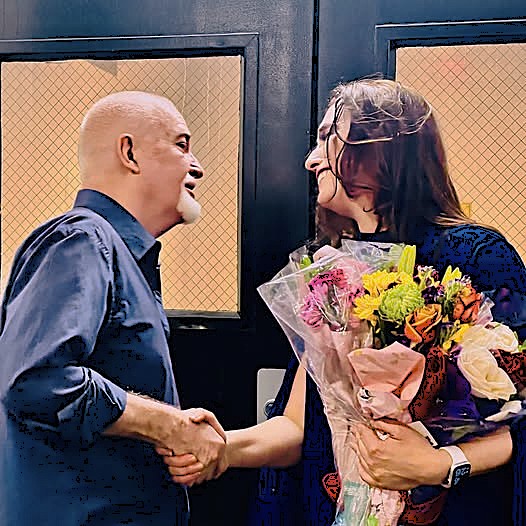
Above photo by Sophia Cerovsek
A huge crowd had gathered at the stage door. I had met Ms. Jaho a couple of years ago, after her Butterfly, and all I could think of to say then was “I love you!” Meeting her at the stage door today, I couldn’t stop myself from kissing her and pounding my heart to express my admiration. She was extremely kind and gracious to this tongue-tied senior citizen. Nice chat with Mr. Meachem…so happy to see him getting the recognition he so richly deserves. I told him he belongs in an echelon of great American baritones alongside Merrill, MacNeil, and Milnes. Kang Wang, who looks like a college sophomore with his youthful build and kindly smile, was engulfed by a number of avid female fans; he had to pose for countless photos.
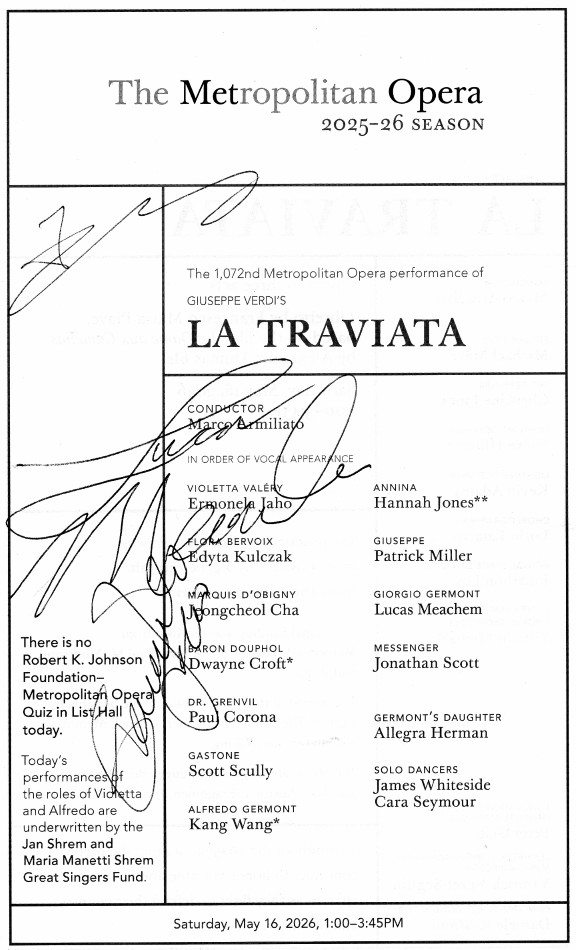
Autographs from Kang Wang, Lucas Meachem, and Ermonela Jaho
Once home, I spent a long time thinking about this performance. It’s so wonderful to find that – after 65+ years of being an opera-lover – I can still find so much to enjoy in these thrice-familiar works, and in the people who sing them now. Some of my friends from my original opera group stopped going after the Last Golden Age ended in the mid-1990s, believing that all the great voices are gone. I can still get excited by today’s singers; and one thing I have learned is, it’s not how loud you can sing, but rather how softly, that makes the magic. For that, Ms. Jaho is a shining beacon.
~ Oberon

