~ Author: Lane Raffaldini Rubin
Friday May 15th, 2026 – One of the joys of chamber music is the intimate bonds that form between musicians who play together for years or decades. For the best chamber ensembles, these bonds translate into nimble motion, interpretive consensus, and a family dynamic.
But chamber music also gives individual players the chance to assemble for just a short time and make “music among friends” for a special occasion or simply for love of a particular piece.
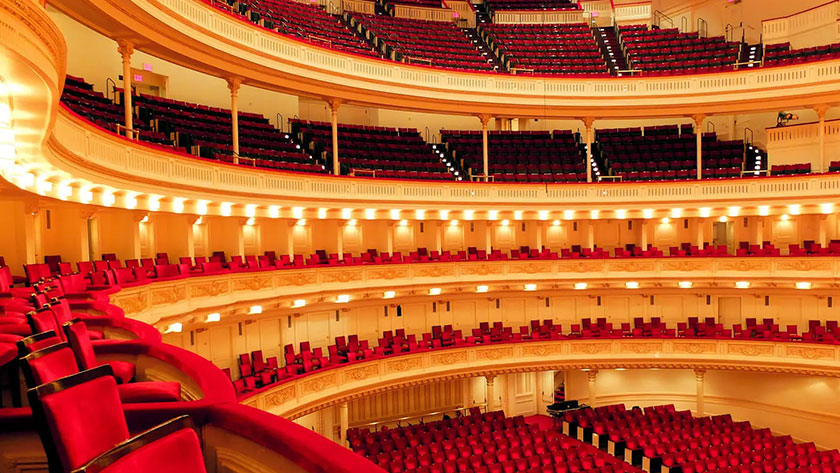
That’s what we heard on Friday at Carnegie Hall: an esteemed group of five soloists forming a one-night-only ensemble to present quintets of Beethoven and Schubert. The results were predictably mixed for exactly the reasons you’d expect from a collection of professional soloists accustomed to the spotlight, but did, predictably as well, produce moments of transcendent music-making.
Carnegie’s marketing billed violinist Leonidas Kavakos’s name first, followed by violinist Gil Shaham, violist Antoine Tamestit, cellist Pablo Ferrández, and cellist Alisa Weilerstein. What stood out throughout the performance was the varying degree to which these musicians molded their playing to the collective.
The first half of the program featured Beethoven’s “Kreutzer” Sonata for violin and piano in an arrangement made for string quintet. The authorship of this arrangement is unknown and has even been attributed to Beethoven himself, an unlikely claim considering the muddy, noisy string texture compared to the vocal clarity of the original.
Throughout the first movement the group struggled to agree on articulation as they passed melodic lines back and forth. They found a groove by the coda, however, which was rendered with sublimely brooding lows and ecstatic highs.
Shaham (who took the first violin part) tends toward the congenial, refined, and Mozartean, which ideally suited the florid figurations of the second movement but was starkly different from Kavakos’s unvarnished, idiosyncratic playing. Tamestit and Ferrández tended to recede into the texture (or, rather, were responsible for the texture), while Weilerstein wended in and out of the foreground. She hammed up the arpeggiated flourishes originally found in the sonata’s piano part and was prone to exaggerated slides. But she brought gorgeous, rocking drive to a passage of triplets transitioning out of one of the slower-tempo variations of the second movement.
The violinists and cellists swapped parts for Schubert’s Quintet in C-Major and offered concentrated substance and unity to its opening statements. The rest of the first movement (and most of the fourth movement) suffered from Kavakos’s mannered articulations and weird push-and-pull on the tempo, which came across as a bit self-indulgent in the context of the quintet, a piece that carries a devotional aura and was clearly the raison d’être for the formation of the night’s bespoke ensemble. This music wasn’t meant for Kavakos, it was meant for all five of them.
All was forgiven in the second movement, which I can only describe as resembling a bolt of exquisite fabric held up to the sunlight, fluttering lightly in a breeze. Kavakos and friends sustained glacially long lines with radiance and imbued prayerlike passages with mysterious, hollow flautando.
Weilerstein, who lucked out with both of the “interesting” cello parts in Beethoven and Schubert, delivered perfectly sturm und drang character to the thundering low triplets of the stormy minor-key middle section of the movement. All five musicians brought emotional intensity and care to every detail, melodic curve, and harmonic turn.
The audience, confusingly, applauded between each section of the Scherzo and gave an ovation at the end of the movement. As a result, the fourth movement had the feeling of an encore. After the piercing final chords, the five musicians took turns hugging before lining up to bow in unison. It may have been a rehearsed gesture, but it was a sweet reminder of the friendship and camaraderie that make great chamber music possible.
~ Lane Raffaldini Rubin

