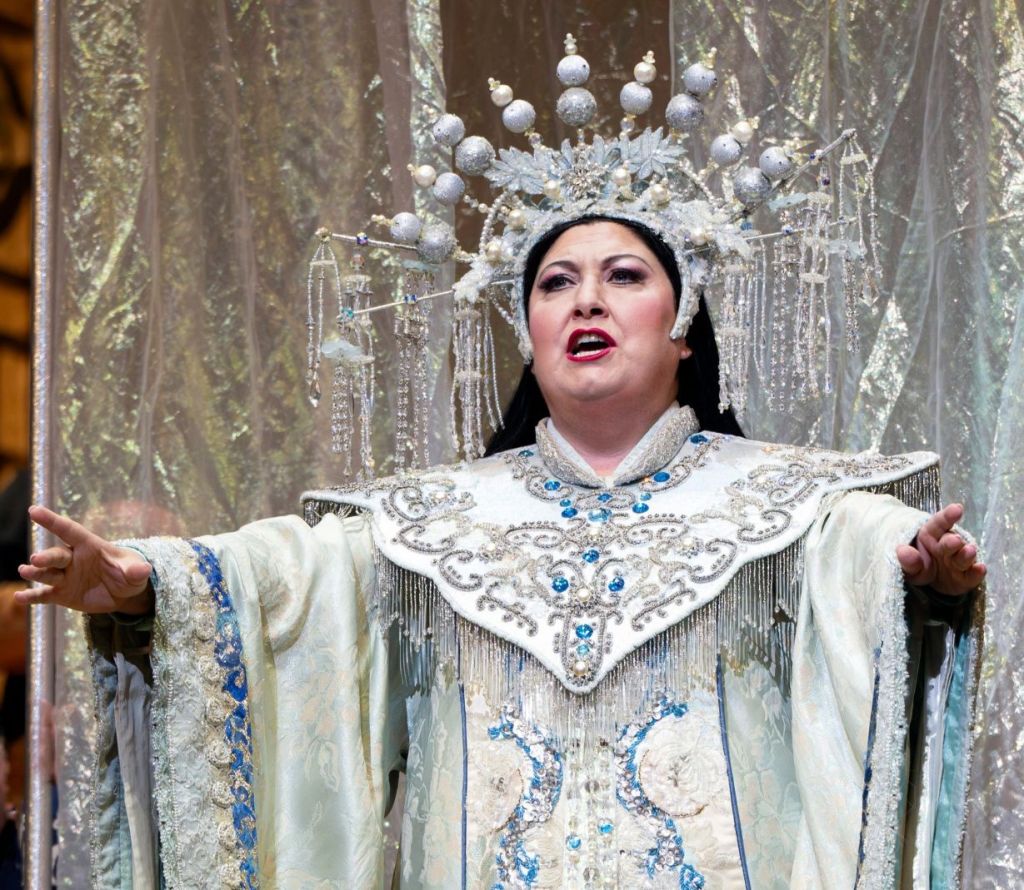
Above: Anna Pirozzi as Turandot/a MetOpera photo
~ Author: Oberon
Saturday May 23rd 2026 matinee – The ever-popular Zeffirelli TURANDOT drew another packed house this afternoon as the Met’s 2025-2026 winds down.
The performance, overall, was one of the most exciting of the current season. The drawback, as is so often the case at The Met now, was the excessive orchestral volume that – while lending a surface excitement – covered the voices too frequently. This particular conductor seems to be a frequent exponent of decibel overload. By the end, a couple of the brass players were cracking from exhausted embouchures. In spite of this, it should be noted that the Met musicians have been playing beautifully all season, and that the chorus has been sounding exceptionally fine.
As has happened at some of my recent Met matinees this season, there were annoying noises coming from the lighting bay lodged in the hall’s ceiling; bits of conversation and – seemingly – of a radio being played filtered down into the seating space along the Family Circle boxes. Ironically, when the important task of flipping on the bow lights so the singers can take their curtain calls is almost always delayed. Today, the applause after Acts II and II had died out completely before the lights came on and the singers came out – almost apologetically – to bow. This would never have happened back in the days when Joe Volpe ran a tight ship.
The first voice to be heard, that of Ben Brady as the Mandarin, made a strong impression. Both here and in his ‘encore’ presentation of “Popolo di Pekino!” in Act II, the bass-baritone made a vivid effect. The unexpected reunion of Calaf and his father, the blind king Timur, brought powerhouse singing from tenor Brian Jagde and basso John Relyea. Angel Blue finished Liu’s “Perche un di...” on a sweet piano B-flat, but the note turned edgy as she increased her volume. The orchestra sounded like a noise machine when the conductor gave them full rein; in softer passages – such as at “O taciturna…”, the magical blend of strings and winds cushioned the choral voices to fine effect. The children’s chorus sounded wonderful, though noises from the lighting bay above us were a distraction.
Brian Jagde’s wonderment at seeing Turandot for the first time commenced dreamily, but the orchestra then swamped him; he pulled thru for a tantalizing “O meraviglia…“. Mr. Relyea’s deep tones resonated thru the hall at “Figlio, che fai?“. The tenor’s massive B-flat as he called out Turandot’s name was nearly covered by the sounds from the pit, though he persevered.
The ministers – Ping, Pang, and Pong – now appear: the outstanding voices of baritone Joo Won Kang and tenors Tony Stevenson and Andrew Stenson made the trio’s singing throughout the afternoon a true pleasure. When their urgings to Calaf that he abandon his quest get too lively, they are silenced by Turandot’s maids – Anne Nonnemacher and Mary K. Hughes – reminding them that this is the hour of their mistress’s repose.
The finale of Act I is at hand; Mr. Relyea pleads memorably with his son, making every note and word count. The ghostly voices of Turandot’s victims gives Calaf pause, but father and son continue their debate powerfully. Angel Blue’s “Signore ascolta…” is voiced with rich, creamy phrases: the emotional pull is palpable, but her voice turned edgy on the final B-flat. Mr. Jadge pours out the passionate phrases of “Non piangere, Liu” with stunning clarity. Mr. Relyea’s deep “Noi morem…” cannot dissuade his reckless son; Relyea’s final plea -“Ah, per l’ultimo volta…” is magnificent, though unheeded. Striking the gong, the tenor’s powerful final B-flat is held forever.
The folks in the lighting bay must have fallen asleep because it took them forever to get the bow lights on so that the singers could step before the iconic gold curtain; the applause had completely stopped before the lights went on and the singers were greeted by a hurricane of applause and cheers. The interminable (45-minute) intermission now commences.
Back in the days of Nilsson, we (then) young fans always resented the Ping-Pang-Pong scene which – to us – held up the much-anticipated appearance of the Great White Goddess (aka The Big B) to nail us to the wall with her laser -beam top notes. Over time, I have come to love this comic/sentimental scene for the three ministers. Though the orchestra kept needlessly threatening to swamp the singers, the three featured subtle dynamic shifts and expert word-play to bring the scene to life. Joo Won Kang’s Ping was outstanding (his character turns cruel in Act III). The ministers rush off to the throne room, and harp glissandi underscore the excitement of the impending riddle scene.
The inimitable Carlo Bosi as Altoum urges Calaf/Jagde to abandon his quest, to no avail. Both singers are verbally acute in their exchange. The harpist continues to enchant. Ben Brady is heard again as the Mandarin…a voice I’ll want to hear more of in the coming seasons, and then – at last – Anna Pirozzi as Turandot stands before us. The soprano, whose fame has preceded her, commences the treacherous “In questa reggia“, quickly establishing herself as a singer of power who is also able to apply intriguing moments of dynamic shading to the great aria. The orchestra builds up until La Pirozzi lets fly a titanic top-B. In the ensuing passages, the orchestra does sometimes cover her in mid- and low- range phrases, but her flaming top notes are always her winning response. She and Mr. Jagde match wits on a top-C of great dramatic thrust. The riddles are now set forth, Ms. Pirozzi tossing down the gauntlet with a thrilling “Straniero…ascolta!“.
The orchestra supplies anxious tension. The soprano’s word-colourings and dynamic demi-tints make the scene even more fascinating than usual. The orchestra tries to cover Jagde’s replies, but he isn’t letting them. When the crowd gets rowdy after the second riddle, the soprano blasts them with the threat: “Percuotete quei villi!” The third riddle is cunningly put forth, the soprano’s beauty of tone is engaged to make Calaf’s anguish even more agonizing. When the correct answer is ringingly given, Turandot turns to her father, singing with intriguing legato, and begging for a reprieve; the Emperor reminds her “E sacra il giuramento...” The orchestra unleashes massive volume, which the soprano over-rides with two glistening top-Cs. Mr. Jagde replies with a ringing top-C of his own, and then – with persuasive lyricism – he offers Turandot a way out.
The orchestra plays gorgeously the dreamlike prelude to Act III, laced with choral interjections. Mr. Jagde’s “Nessun dorma” is super: such a generous outpouring of tone, his poetic phrasing and verbal nuances etched in to make it all the more alluring. The ovation he received was thunderous, and so well-deserved.
Joo Won Kang’s Ping has many opportunities to shine now; his “Ebbene, prendi!“, “Straniero tu non sai..” and “Principessa divina...” are all spot-on. Liu and Timur are brought in, and Ping presides over the drawing out of the Unknown Prince’s name thru torture. The orchestra here is needlessly loud much of the time. Ms. Blue’s steadfastness at first holds true, but her scream draws a poignant “Perche gridi?” from the confused Timur. The exchange between Mmes. Blue and Pirozzi is finely sung, though the former is a bit wiry in spots. Ping powerfully calls for the executioner, Pu-Tin-Pao. Angel Blue’s “Tu che di gel…” is superbly phrased, despite her highest notes being a bit shaky.
Liu’s death evokes a tormented “…tu sei morta!” from Calaf. John Relyea’s plea for his “little dove” to awaken is interrupted by the cruelty of Jon Wong Kang’s bitter “Àlzati, vecchio! È morta!” Mr. Relyea’s singing here is stupendous. ending with a crushing “Vendicherò! ” The old king then bids a heart-rending farewell to the slave girl who had devoted herself to his care because, one day, Calaf had smiled at her.
In the ensuing duet for Turandot and Calaf, the orchestra too often covers the voices. Both sing gloriously, Ms. Pirozzi’s ethereal “E l’alba…” and her singing throughout “…del primo pianto” (amazing that this passage was sometimes cut back in the day) was radiant, her haunting “…il tuo mister!” lingering on the air. Calaf reveals his name. Soprano and tenor duel vocally with competitive, high-lying passages. Before the emperor, Turandot reveals the name of her prince: “It is love!“. The orchestra and chorus pour out a massive finale, while I am thinking of an alternate ending that I’ve always wished to see.
Tumultuous ovation: great enthusiasm – thoroughly deserved – for the singers. I went to the stage door, where I met Mssrs. Jagde and Relyea – each of who have a handshake to match their powerful voice – and the lovely Ms. Pirozzi, who let me give her a hug. Such a great end to a great season for me.
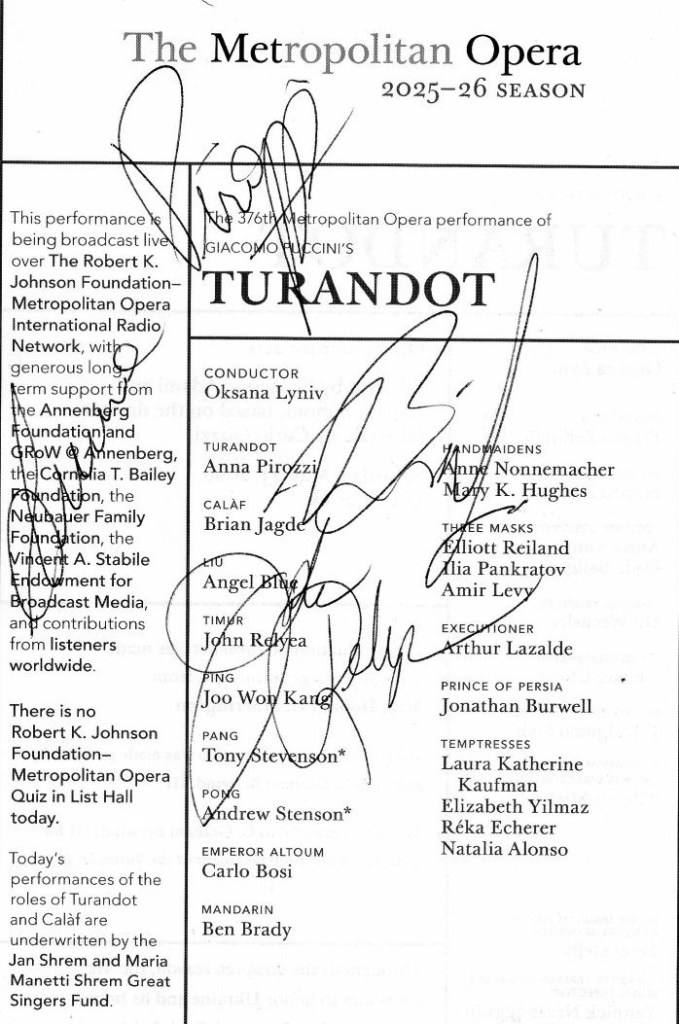
Above, signed by Ms. Pirozzi and Mssrs. Jagde and Relyea
(Angel Blue’s passing troubles with notes in her highest range were not disastrous by any stretch, but her seeming insecurity at those moments prompted me to think that a change of fach might be a good idea. With her warm, plush sound, she could easily move into the great mezzo-soprano roles like Carmen, Dalila, Laura Adorno, Santuzza, Dido (Berlioz and/or Gluck), Brangaene, Charlotte…)
~ Oberon

