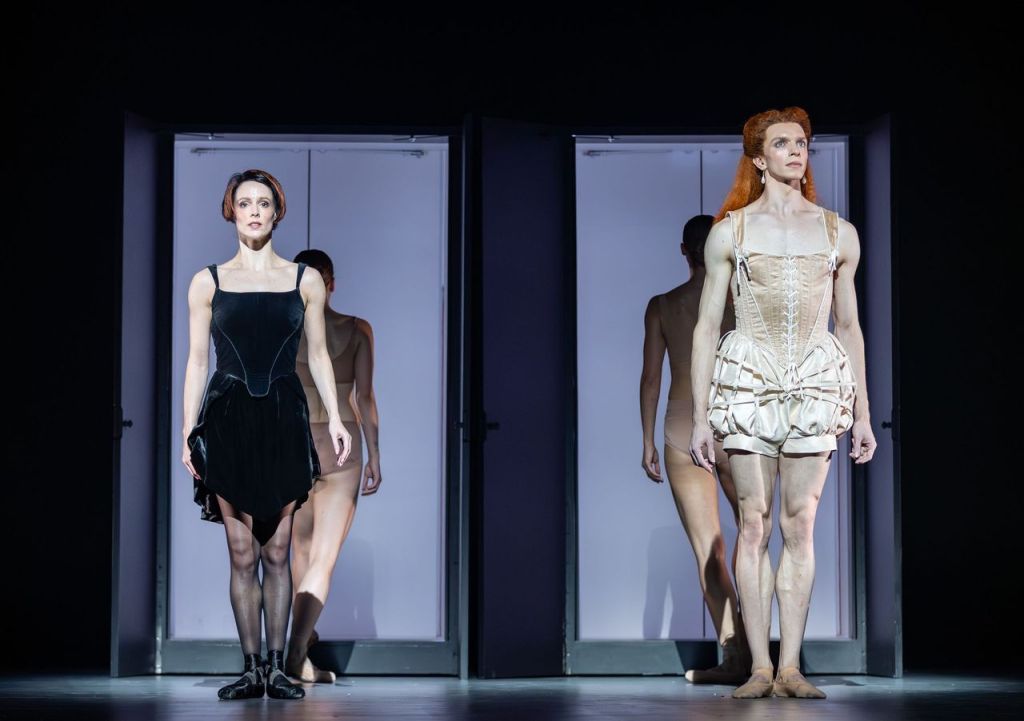
Above: Roseanna Leney as Mary Stuart and Harvey Littlefield as Elizabeth II; photo courtesy of Scottish Ballet
~ Author: Oberon
Sunday June 7th, 2026 matinee – Mary Stuart has been with me for a long time. As my miserable high school years drew to their end, and tired of reading boring books assigned by my various English teachers, I went to the nearest bookstore in Oswego, New York, and bought two biographies. One was of Napoleon Bonaparte, and the other was Antonia Fraser’s classic bio of Mary, Queen of Scots.
I found Mary’s life infinitely more interesting than Napoleon’s. This favoring of women’s life stories would hold true over many years; biographies of Isadora Duncan, Renata Tebaldi, Cosima (and Winifred) Wagner, Lydia Sokolova, Mathilde Wesendonck, Gelsey Kirkland, Misia Sert, Dame Janet Baker, and Janis Joplin are still on my shelf, whereas only Balanchine, Diaghilev, and Richard Wagner represent my male idols. I’ve got the Fraser biography here next to me as I write this.
Long ago, I fell in love with Donizetti’s opera about the tragic Scots Queen, MARIA STUARDA, which is built around a fictitious meeting between Mary and her Tudor cousin, Elizabeth II of England. Ever suspicious of the Catholic Mary, Good Queen Bess imprisoned Mary, who had fled rebellion in Scotland and incautiously chosen England over France (where she was already Dowager Queen) as a place of refuge. In the ensuing long years, Mary was ever a thorn in Elizabeth’s Protestant side; in the end, Mary was found guilty of encouraging a plot to rescue her from her prison. Mary, Queen of Scots, was 44 years old when she was executed on February 8th, 1587, at Fotheringhay Castle. Elizabeth later claimed that she had been tricked into signing the death warrant by her secretary, who had conveniently hidden the warrant in a stack of routine documents needing the Queen’s signature.
Irony of ironies: when Elizabeth died childless, she named – on her deathbed – Mary Stuart’s son, King James VI of Scotland, as her heir. He became James I of England; every British monarch since the 17th century can trace their descent back to him. This lends meaning to one of Mary Stuart’s final musings: “In my end is my beginning.”
I apologize for the preceding detour from the matter at hand: the Scottish Ballet’s MARY, QUEEN OF SCOTS.
Choreographed by Sophie Laplane to a musical score by Mikael Karlsson and Michel P. Atkinson, with sets and costumes by Sutra Gilmour, lighting by Bonnie Beecher, and projections and visuals by Anouar Brissel. The production is directed by co-creator James Bonas.
Looking thru some production photos prior to attending this matinee, I wondered how (and how much) of Mary Stuart’s story could be told in a two-hour dancework. Two men who loomed large in Mary’s life once she returned to Scotland following the death of her first husband, the dauphin (and, briefly, king) of France, were not named among the ballet’s characters: the fiery opponent of Catholicism in Scotland, John Knox, whose public attacks on Mary deeply troubled her, and the madman Lord Bothwell, Mary’s third husband, who caused Mary’s fall from grace with her people, and her eventual flight from her homeland.
Elizabeth had sent her favourite, the dashing and spirited Lord Darnley, to Scotland, to court Mary; the young queen succumbed to his charms, married him, and thus gave Elizabeth a tighter leash on her cousin. Darnley was both jealous of, and intrigued by, David Rizzio, Mary’s Italian court musician. The two men reputedly had an affair, and Darnley’s jealousy of Mary’s apparent infatuation Rizzio brought about the musician’s violent death. When Darnley later fell ill and was quarantined in a small house near the castle, he was himself murdered in a gun-powder blast which, some say, was master-minded by Mary herself. In the ballet, Darnley and Rizzio have a passionate pas de deux. Another set of historically correct characters, the “Four Marys” who were the queen’s constant companions, are included in the story-telling.
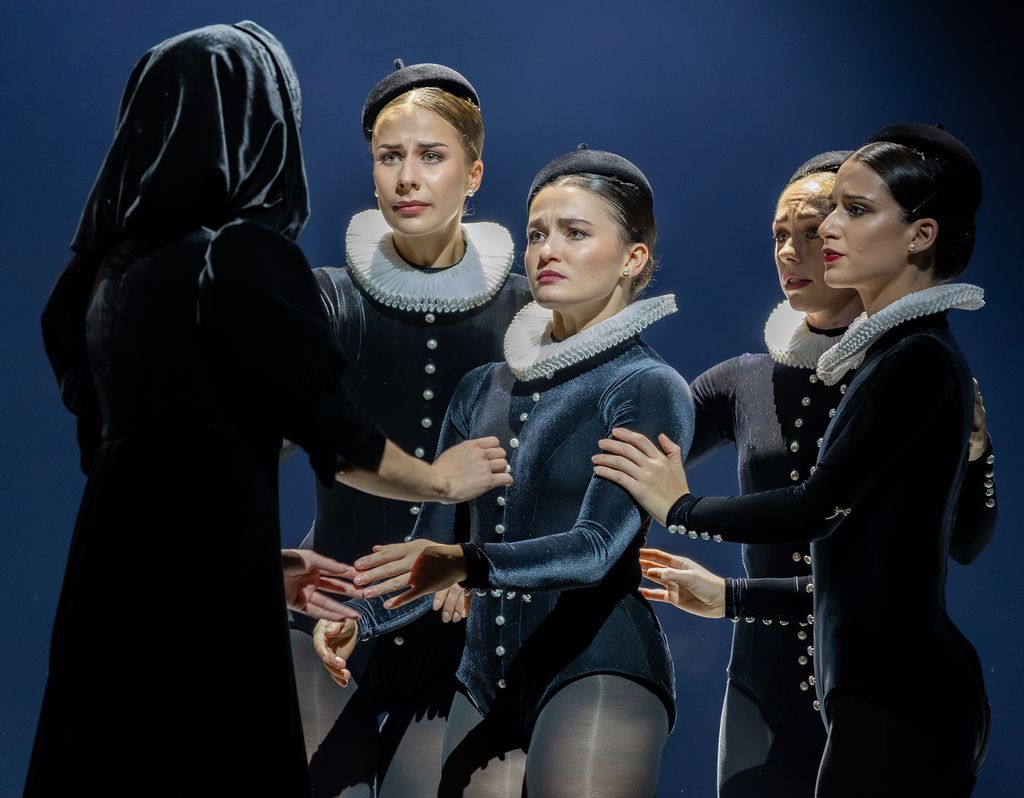
Above: Mary Stuart and the Four Marys
We arrived at the theatre to find that they had run out of program booklets. Luckily, I had received the necessary casting information in advance from the publicist, but people sitting near us were left in the dark as to details of the narrative and who was dancing which role.
The physical production was both grandly stark and imaginatively lit. I was glad to find the story-telling (mostly) clear and accurate. So many incidents from Mary’s life that I thought might be glossed over were etched into the staging; details of her execution – the three warning cannon-shots, and her red petticoat (here, a bikini!) as a sign of her martyrdom – were rightfully included, though (mercifully) her final agony was not shown: the executioner had missed his mark on the first blow, extending her suffering as he hacked her head off.
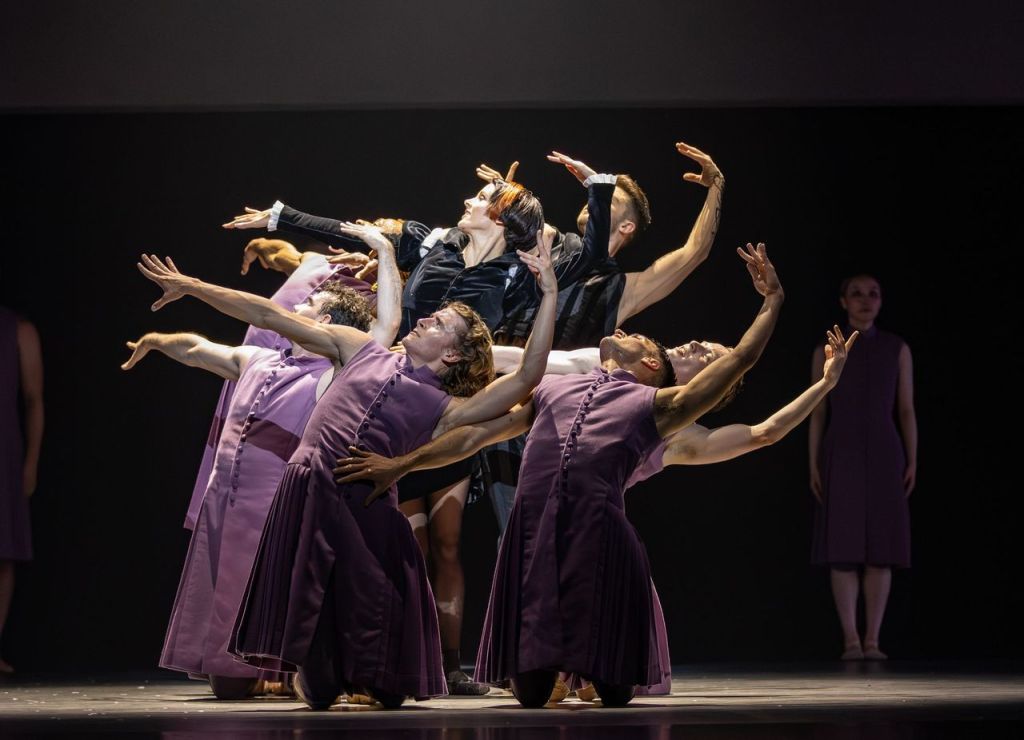
Above: Mary Stuart (Roseanna Leney) and her courtiers; photo by Alex Ross
The Scottish Ballet’s dancers were very well-cast: Roseanna Leney as Mary was ideal – especially as fate closed in on her – as were Nicol Edmonds as Darnley and Bruno Micchiardi as Rizzio. The two men engaged convincingly in a torrid love/sex duet; later, the murder of Rizzio was depicted in all its merciless chaos. Charlotta Ofverholm made a strong impression as the “Old” Elizabeth; as her more youthful counterpart, Harvey Littlefield strode about convincingly on stilts. Court jesters are often annoying – I think it’s part of their job description – and Kayla-Maree Tarantolo, in a chartreuse frock and pointy hat, played her busybody role out to perfection. Meanwhile, a child with his name “James” emblazoned on his shirt, wandered haplessly about, unaware of what the future held for him.
Adding immensely to the power and persuasiveness of the performance was the score by Mikael Karlsson and Michel P. Atkinson. Allusions to dance rhythms and instrumentations of the Tudor period kept us engaged; the music and the drama were ideally entwined, making the afternoon pass by with a mixture of vivid urgency and somber severity that proved compelling.
Whether or not the audience – wonderfully silent and attentive – were able to understand what they had just experienced without the help of a printed program, it seemed not to matter: the applause was loud and long, the dancers rightfully cheered.
In December, Mary Stuart will be back at Lincoln Center when The Met gives the Donizetti opera with my beloved friend Lisette Oropesa in the title-role.
(Performance photos courtesy of Scottish Ballet)
~ Oberon
.

