Author: Philip Gardner

  • Accordion & Saxophone @ The Morgan Library

    Yca

    Above: Steven Banks and Hanzhi Wang

    Tuesday February 22nd 2023 – Young Concert Artists presenting a noontime concert at The Morgan Library featuring the unusual combination of accordion and saxophone. The players – Hanzhi Wang (accordion) and Steven Banks (saxophone) – have both previously appeared at The Morgan in solo recitals; they are brilliant, unique artists, and I was eager to hear them live again. But the afternoon did not turn out as planned.

    We settled into our seats, but after a few minutes we were shivering. We put our coats back on, but the damp chill was pervasive. Looking around, it seemed that everyone in the audience was bundled up, and I was recalling an evening many years ago when the young Frederica von Stade gave a recital in a frigid hall in Syracuse, NY, where the maintenance staff had inadvertently shut off the heat; luckily, someone located a small space heater which was set up onstage to keep the singer somewhat warm.

    This afternoon’s musicians took the stage, Mr. Banks towering over the petite Ms. Wang. They launched their program with an arrangement of Handel’s Recorder sonata in G-minor, HWV 360; it took a moment to adjust to the brighter sound of the saxophone in music we are accustomed to hearing played with the softer timbre of the recorder, but Mr. Banks immediately scaled back his dynamic palette, bringing delicious subtleties to the music. Meanwhile Ms. Wang, looking so lovely in her pleated white frock, transformed her accordion into a compact organ, playing with such cordial tone and bending the phrases with consummate skill. As he music veered from courtly to festive, the players were wonderfully in sync and so attentive to one another, making for a musical treat.

    Three miniatures by Krzysztof Penderecki – the great and sorely missed Polish master-composer – were so fascinating to hear. The first, Allegro, is weirdly spastic; it seems to reach its quirky end in a matter of seconds, with the players wryly relishing the innate humour of the piece. A dark and doleful Andante cantabile followed, the timbres of the two instruments blending to perfection. The concluding Allegro ma non troppo is a bouncy dance, polished off zestfully by Ms. Wang and Mr. Banks.

    Now Ms. Wang offered excerpts from Bach’s Goldberg Variations: the very familiar Aria, played with great depth of feeling, followed by four variations which called for all manner of fanciful fiorature, dispatched with effortless grace and polish by this remarkable virtuoso.

    Virtuosity continued in abundance as Ms. Wang gave us two works by Martin Lohse: Autumn Rain, with its dotty raindrops sparklingly defined, and the more somber Winter’s Tale, in which gentle snowflakes drift down on an overcast wintry afternoon. Ms. Wang’s incredible dexterity was simply mind-boggling to observe, her fingers flying nimbly over the keys as she spun out the music, much to our delight.

    But we were now chilled to the bone, and we silently agreed that we needed to leave and seek some warmth. We slipped up the stairs as the stage was being set for the next piece, and a few other audience members followed us out. I was sorry to miss Mr. Banks’s set, and the anticipated Astor Piazzolla finale.

    ~ Oberon

  • Ensemble Connect @ Weill Hall

    Connect = Photo-Credit-Fadi-Kheir jpg

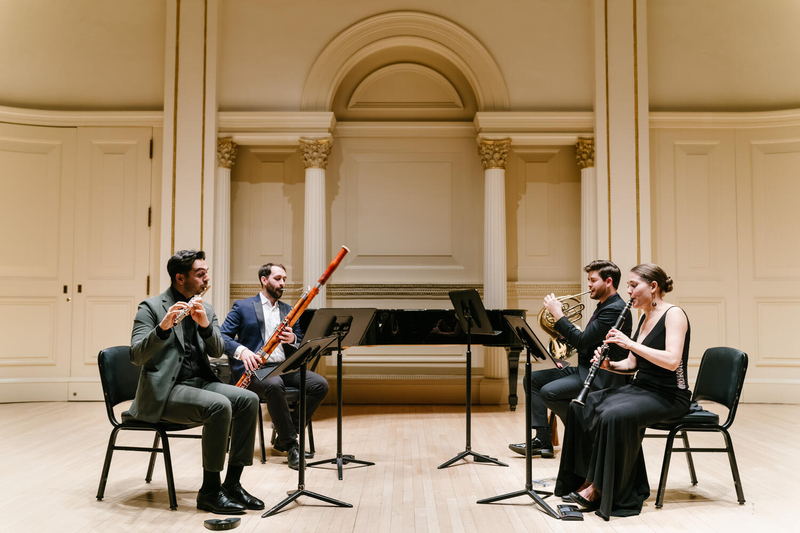
    Above: the artists of Ensemble Connect; photo by Fadi Kheir

    Author: Oberon

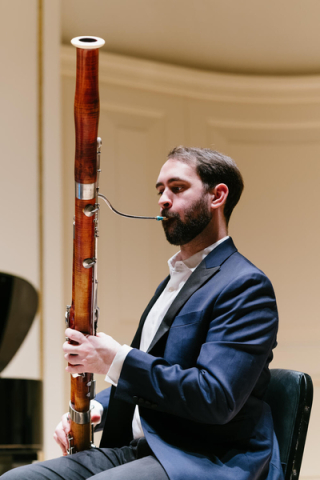
    Tuesday February 21st 2023 – Ensemble Connect offering a wide-ranging program at Weill Hall this evening, opening with Jennifer Higdon’s Dark Wood, a work for bassoon and piano trio. Nik Hooks, the Ensemble’s excellent bassoonist, kicked off his busy evening here (he played in three of the four works); for the Higdon, he was joined by pianist Joanne Kang, cellist Laura Andrade, and guest violinist Stephanie Zyzak. The piece’s title refers to the lustrous, deep-dark polish of the bassoon. 

    Dark Wood opens with staccati for the bassoon and piano; the plucking violin and cello soon join. The music is jagged, buzzing with trills and big accents, full of nervous energy. A prolonged note for bassoon launches a sprightly, animated passage; then the piano begins to rumble, the bassoon and cello playing deep. Another long, dark bassoon tone leads to slithering strings and a pulsing piano motif.

    CH11325029

    Above: bassoonist Nik Hooks; performance photo by Fadi Kheir

    The violin and cello sigh, and things turn dreamy. Dotty violin notes sound over a wistful bassoon melody and then the cello offers a rich theme; this is all quite beautiful to hear. Things perk up, with the bassoon trilling and the strings sizzling, and then Ms. Kang at the keyboard takes over, with big playing, agitated and insistent. Heartfelt strings and a forlorn song for bassoon and piano follow; Ms. Kang offers plucked notes with a “prepared piano” sound, the others playing poignantly. Now the music rushes forward, somewhat chaotically, to a brisk finish.

    Ms. Kang and Mr. Hooks were soon back onstage for Mozart’s delightful Quintet for Piano and Winds in E-flat Major, K. 452, joined by three more of the Ensemble Connect’s brilliant wind players: Amir Farsi (flute), Jasmina Spiegelberg (clarinet), and Cort Roberts (horn).

    Mozart apparently thought highly of this piece, and he would doubtless have loved this evening’s performance of it. It opens rather hesitantly; Mr. Roberts plushy, golden tone immediately grabbed me,  frustrated high-school horn player that I am. The blend of wind voices was sonorous, and after the piano introduces a new and more animated theme, it is passed about from instrument to instrument.

    CH11325032

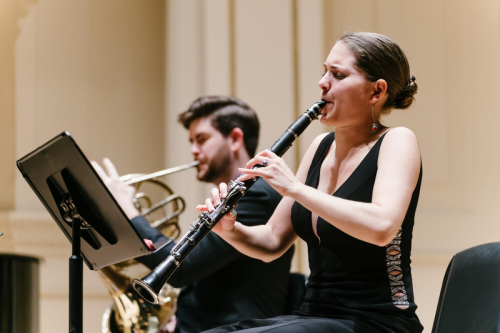
    Above: Cort Roberts (horn) and Jasmina Spiegeberg, clarinetist; performance photo by Fadi Kheir

    The Larghetto brings us a gracious, courtly melody, with Ms. Spiegelberg’s lambent tone and persuasive phrasing leading the way; flute, horn, and bassoon take up the line in succession. A bel canto atmosphere  develops, with the piano offering accentuations; Mr. Roberts’ horn cavatina is so stylish, with the others harmonizing expressively.

    The final Rondo/Allegretto rolls along, each player showing a vibrant sense of virtuosity: a sustained flute trill from Mr. Farsi was but one of many decorative delights.

    Wiancko

    Above: composer Michi Wiancko

    Michi Wiancko’s 7 Kinships, a Carnegie Hall commission, was having its New York premiere this evening. The composer charmingly introduced the work; she spoke of how 7ths and 9ths express a feeling of longing. I could not agree more.

    CH11325030

    Above: The evening’s wind players – Mssrs. Farsi, Hooks, and Roberts, and Ms. Spiegelberg – giving a sterling performance of the Wiancho; performance photo by Fadi Kheir

    In the work’s seven brief movements, Ms. Wiancho’s thoughtful craftsmanship gave the players ample opportunity to revel in their artistry. The music ranges from lyrical to animated, with moods veering from  whimsical to lamenting. The sounds of the instruments entwine to delight the ear, sometimes in strange harmonies, whilst rhythmically the composer displays touches of wit. The musicians seemed to genuinely enjoy playing this music.

    Before commencing the program’s final work, Robert Schumann’s Piano Quintet, violist Halam Kim read one of the composer’s letters to his beloved Clara; I admit this outpouring of love brought tears to my eyes. And then to recall that it was Clara who played the quintet’s demanding piano part at the work’s public premiere, making it all the more touching.

    CH11325026

    Above, playing the Schumann: Mr. Rengel, with Mlles. Zyzak, kang, Andrade, and Kim; photo by Fadi Kheir

    The Ensemble Connect’s marvelous violinist, Rubén Rengel, led the ensemble, with Ms. Kang honoring Clara Schumann with her delectable playing, and Mlles. Zyzak, Kim, and Andrade all sounding gorgeous.

    This beloved work is bursting with magical passages: the ‘dialogue’ for cello and viola in the opening movement, a theme to which Mozart frequently returns, is especially endearing, and in the dirge-like second movement, Mr. Rengel ‘s playing is exceptional. Mlles. Zyzak and Kim take ups this calmly funereal theme, and Ms. Abdrade’s sumptuous tone is ever at the heart of the matter.

    In the bustling Scherzo, Mr. Rengel is again in his element, and Ms. Kang has much to do, her rising scales setting the scene for a fast dance, her music-making on the grand scale. It is Ms. Kang who initiates the final Allegro ma non troppo with her scintillating playing. A hymn-like interlude arises, and then low rumblings from the piano develop into a slow sway; this then accelerates, dancing us on to the finish.

    All performance photos by Fadi Kheir, courtesy of Carnegie Hall.

    ~ Oberon

  • Bernadette Greevy

    Bernadette-Greevy

    Bernadette Greevy (above), the Irish contralto, was born in Clontarf, a coastal suburb of Dublin.  She studied voice with Jean Nolan and at the Guildhall School of Music and Drama, in London, with Helene Isepp. Her operatic debut was at Dublin, as Siebel in Gounod’s FAUST; she was 18 years old. At the Wexford Festival in 1962, she debuted as  Beppe in Mascagni’s L’AMICO FRITZ, returning often to Wexford in the ensuing seasons to sing operas by Verdi, Massenet, Haydn, and Handel.

    Ms. Greevy appeared with Scottish Opera and at Covent Garden, as well as in Buenos Aires, Oslo, and Ottawa, and made concert tours of China (in 1985), the USA, and throughout Europe. She became best-known for her recital and concert work. Her performances of Elgar’s Sea Pictures and the great Mahler vocal works – Songs of a Wayfarer, the Rückert Lieder, the Kindertotenlieder, and Das Lied von der Erde – were highly acclaimed.

    Bernadette Greevy passed away in 2008 at the age of 68, leaving us with some very fine recordings of her Elgar and Mahler specialties as well as music of Bach, Handel, Berlioz, Brahms, and Duparc. Below are some samplings of the Greevy voice; it takes a few seconds for the Handel to start.

    Bernadette Greevy – Lascia ch`io pianga ~ Handel’s RINALDO

    Bernadette Greevy – Mahler ~ Ich bin der Welt abhanden gekommen

  • Rarity: Honegger’s “Les Mille et Une Nuits” (1937)

    Edouard_kriff_02

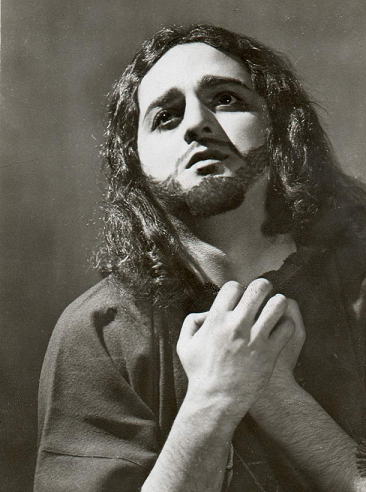
    Above: Édouard Kriff as Samson

    Searching for recordings by the Algerian tenor Édouard Kriff, I came upon this delicious work by Arthur Honegger: LES MILLE ET UNE NUITS (A Thousand and One Nights) written in 1937: LINK

    I found these very informative paragraphs about Édouard Kriff by Philippe Olivier of The Orel Foundation:

    “During Kriff’s first contract year at the National Opera House of Paris of September 1938, he sang the roles of Samson, Radames and Faust in LA DAMNATION DE FAUST by Berlioz. After the armistice of June 1940 , he appeared at the National Radio, mostly under the direction of Paul Bastide, in thirty leading roles. Denounced as a Jew by employees of the theater, he was arrested by collaborationist French police on 22 January 1943, along with his mother, but he escaped by jumping from the train to Sobibor; Kriff joined up with the snipers and partisans operating in the Ardèche.

    In 1944, the tenor resumed his activities at the Opéra-Comique, where he sang Don José, Werther, Hoffmann and Canio in PAGLIACCI. He sang Julien in Charpentier’s LOUISE in 1950. From 1956 to 1958 he was stage director of the Opéra-Comique.”

    Cernay1

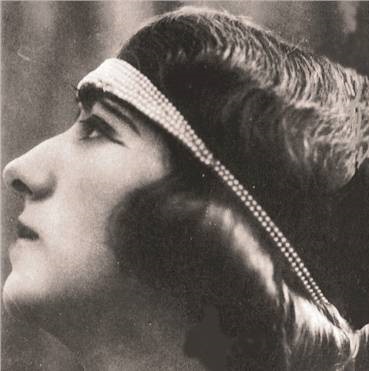
    It’s also wonderful to hear Germaine Cernay (above) in this exotic Honegger work. She’s long been a favorite of mine among voices from the past. Cernay she made her debut in 1925 at the Paris Opéra in Fauré’s Pénélope. She was a beloved star at the Opéra-Comique (Salle Favart), where she made her debut in 1927 in Alfano’s Risurrezione opposite Mary Garden and went on to appear there as Mallika (Lakmé), Suzuki, Mignon, Geneviève, Carmen, and Charlotte. She was also a favorite at La Monnaie, Brussels, and sang often at provincial French opera houses. She toured North Africa, England, Ireland, Italy, and Switzerland. Cernay is remembered as a fine interpreter of J.S. Bach.

    Germaine Cernay was deeply religious, and in 1942 she retired from the stage and prepared to take her vows as a nun. She died – of an epileptic seizure – in 1943, before having fulfilled her wish to enter the convent.

    Germaine Cernay sings Nevin’s The Rosary

    CLOEZ - 1959

    The Honegger is conducted by Gustave Cloëz (above).

  • Rarity: Honegger’s “Les Mille et Une Nuits” (1937)

    Edouard_kriff_02

    Above: Édouard Kriff as Samson

    Searching for recordings by the Algerian tenor Édouard Kriff, I came upon this delicious work by Arthur Honegger: LES MILLE ET UNE NUITS (A Thousand and One Nights) written in 1937: LINK

    I found these very informative paragraphs about Édouard Kriff by Philippe Olivier of The Orel Foundation:

    “During Kriff’s first contract year at the National Opera House of Paris of September 1938, he sang the roles of Samson, Radames and Faust in LA DAMNATION DE FAUST by Berlioz. After the armistice of June 1940 , he appeared at the National Radio, mostly under the direction of Paul Bastide, in thirty leading roles. Denounced as a Jew by employees of the theater, he was arrested by collaborationist French police on 22 January 1943, along with his mother, but he escaped by jumping from the train to Sobibor; Kriff joined up with the snipers and partisans operating in the Ardèche.

    In 1944, the tenor resumed his activities at the Opéra-Comique, where he sang Don José, Werther, Hoffmann and Canio in PAGLIACCI. He sang Julien in Charpentier’s LOUISE in 1950. From 1956 to 1958 he was stage director of the Opéra-Comique.”

    Cernay1

    It’s also wonderful to hear Germaine Cernay (above) in this exotic Honegger work. She’s long been a favorite of mine among voices from the past. Cernay she made her debut in 1925 at the Paris Opéra in Fauré’s Pénélope. She was a beloved star at the Opéra-Comique (Salle Favart), where she made her debut in 1927 in Alfano’s Risurrezione opposite Mary Garden and went on to appear there as Mallika (Lakmé), Suzuki, Mignon, Geneviève, Carmen, and Charlotte. She was also a favorite at La Monnaie, Brussels, and sang often at provincial French opera houses. She toured North Africa, England, Ireland, Italy, and Switzerland. Cernay is remembered as a fine interpreter of J.S. Bach.

    Germaine Cernay was deeply religious, and in 1942 she retired from the stage and prepared to take her vows as a nun. She died – of an epileptic seizure – in 1943, before having fulfilled her wish to enter the convent.

    Germaine Cernay sings Nevin’s The Rosary

    CLOEZ - 1959

    The Honegger is conducted by Gustave Cloëz (above).

  • More Schubert @ Chamber Music Society

    Ben beilman

    Above: violinist Benjamin Beilman

    Sunday January 29th, 2023 – Continuing their Schubert-centric Winter Festival, Chamber Music Society of Lincoln Center today offered a full evening of the master’s works, performed by an elite sextet of artists.

    Schubert’s Adagio and Rondo concertante in F-major for Piano, Violin, Viola, and Cello, was composed in 1816. It is essentially a miniature piano concerto. At the Steinway, Gloria Chien was joined by Benjamin Beilman (violin), Paul Neubauer (viola), and David Requiro (cello).

    Extraordinary richness of tone as the players struck up the introductory phrases; Mr. Beilman then set forth with a dreamy melody. Ms. Chein’s crystal-clear technique offered a counter-song to the dense string harmonies as the music turned dramatic and then sprightly. Things get quite merry, with dancing rhythms propelled by vivid bowing. The music turns delicate before accelerating to a lively finish.

    For the composer’s Allegro in A -minor (“Lebensstürme”), dating from 1828, the pianists were Wu Han, taking the lower octaves, and Alessio Bax, taking the upper. From its dramatic start, the music has a restless quality. Passages of extroverted energy mingle with wonderfully subtle moments: huge crashing chords give way to a haunting misterioso passage, and sharp attacks are becalmed by a poignant, pensive theme. Suddenly, silence falls. And then the pianists play on to a swift finish. 

    Ben Beilman, looking very dapper in his velvet jacket, and pianist Gloria Chien then blew the roof off Alice Tully Hall with their sensational playing of the long and demanding Fantasy in C-major for Violin and Piano, composed in 1827. To Ms. Chein’s lovely, rippling piano modulations, Mr. Beilmen embarked on an achingly gorgeous violin theme, his playing so hushed and tender as he spun out magically pure sustained tones at super-pianissimo. The audience seemed to hold its collective breath, overcome by the sheer beauty of the playing.  

    Now a charming allegro springs up. The music – lilting, light, and dazzling – calls for festoons of fiorature from both players. After a dramatic outburst, with searing violin phrases, a piano cadenza restores peace. Then, in a moment of total silence, a cellphone sounded; I momentarily thought Mr. Beilman was going to stop playing, but instead he countered the intrusion with playing of ineffable sweetness.

    The music turns dancelike, with the violinist alternating edgy plucking with sweeping upward phrases. Virtuoso playing from both artists leads to an interlude, and to a gossamer violin cadenza. Then we return to the beginning: to the enchantment of the work’s first measures. Now commences an onward flight towards the finish, with Mr. Beilman’s incredible tremelos on succeeding notes taking on the air of a demented fiddler. As their astounding performance reached its end, the crowd’s pent up excitement burst forth in a tidal wave of applause and cheers; Ms. Chein and Mr. Beilman faced a full-house standing ovation as a great feeling of joy filled the hall.

    CMS_100721_Gloria_Chien

    Above: pianist Gloria Chien

    Following the interval, Wu Han strode onto the stage in her ruby-red shoes to tell us about some of the programs CMS will be offering in their 2023-2024; we picked up brochures in the lobby after the concert, and immediately marked off several dates to put on our calendars.

    The evening’s concluding work, also composed in 1827, was the Trio No.1 in B-flat major for Piano, Violin, and Cello. For this, Mr. Bax joined Mssrs. Beilman and Requiro.

    The trio’s movement, marked Allegro Moderato, begins in a celebratory mood. It’s lovely to welcome Mr. Requiro back to Alice Tully Hall: he is a cellist of noble tone, capable of great subtlety; here, he takes up a serene melody, to be joined soon after by Mr. Beilman. As the movement flows on, the two string players are heard in unison or with their timbres entwining. Mr. Bax’s playing is so fluent, and with a keen sense of timing.

    In the ensuing Andante un poco mosso, Mr. Bax leads off with a lullabye-like theme; the cello then commences a familiar melody, which is later passed on to the violin and piano. Mr Beilman’s flawless dynamic control is again something to relish, whilst the sound of Mr. Requiro’s cello tore at my heart. Counter-melodies and elegant tonal blends illuminate the music, which has a heavenly conclusion.

    The light and lively Scherzo Allegro draws on dance rhythms. It comes to a full stop, then rebounds, with fresh themes being passed from player to player. The concluding Rondo, with its sprightly start, is full of witty dotted motifs, arpeggios, and trills. The music dances on to a merry finish, leaving the players to savor the audience’s grateful applause and shouts of bravo!

    ~ Oberon

  • Dialogues des Carmélites @ The Met

    Gigliotti goerke marty sohly

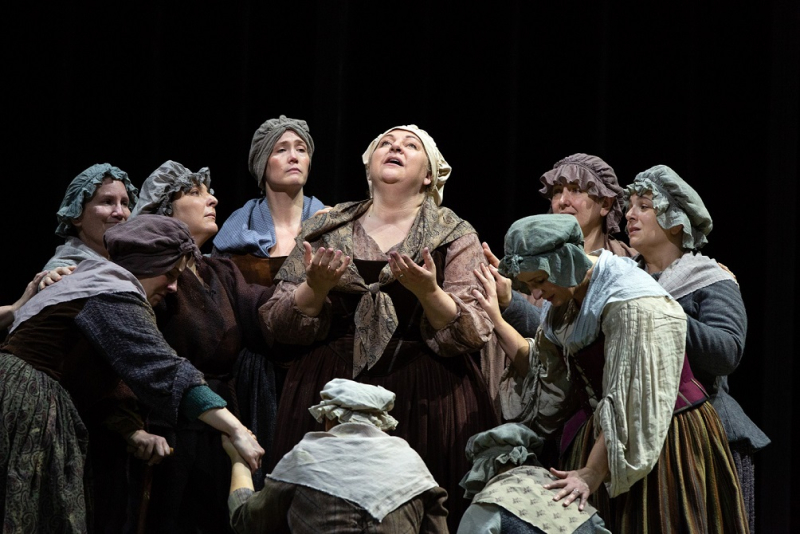
    Above: Christine Goerke as Mme. Lidoine with Eve Gigliotti as Mother Jeanne, and their sister-nuns; photo by Marty Sohl/Metropolitan Opera

    Saturday January 28th, 2023 matinee – An incredibly powerful performance of Francis Poulenc’s masterpiece, Dialogues des Carmélites, at The Met this afternoon. The John Dexter production, one of the treasures of the Company’s repertoire, never fails to move me with its utter simplicity and the clarity of its story-telling. It was lovely to see several small groups of nuns among the audience this afternoon.

    The performance was somewhat compromised by the conducting of Bertrand de Billy; though his tempi and feel for the music were spot-on, he too often allowed the orchestra to cover the voices. This seems to be a trend at the Met these days, for the recent RIGOLETTO(s) and TRAVIATA I saw, conducted by Speranza Scapucci and Marco Armiliato respectively, suffered from the same problem. As there are no huge voices around nowadays – no Nilsson, nor even a Grob-Prandl, and no Cossotto, del Monaco, or Norman Treigle either – such waves of sound rising from the pit cause singers to either force or simply be drowned out. The Met’s huge space is hard enough fill in and of itself; having to compete with mega-decibels of orchestral sound must be daunting indeed. Perhaps some people feel that a high-volume orchestra makes opera more “exciting”…? Well, it doesn’t.

    The cast today was peopled by expressive singing-actors, down to the smallest roles. Benjamin Taylor (Thierry), Paul Corona (Dr. Javelinot), Siphokazi Molteno (Sister Mathlde), and Jeongcheol Cha (Jailer) did well, though the last-named’s task – reading the names of the nuns condemned to death – was lessened in impact by the orchestra’s loudness; it’s an affecting moment, deserving to be better-handled.
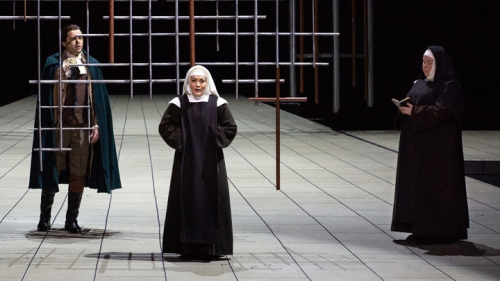
    Piotr Buszewski Perez Barton

    Above: Piotr Buszewski as Chevalier de la Force, Ailyn Perez as his sister Blanche, and Jamie Barton as Mother Marie; photo by Marty Sohl/MET Opera

    The Polish tenor Piotr Buszewski, in his Met debut role, displayed a handsome timbre and fine sense of nuance as the Chevalier de la Force. Laurent Nouri made his mark as the Marquis de la Force. Tony Stevenson was excellent as the Chaplain, and Eve Gigliotti made much of the moving role of Mother Jeanne. It is Mother Jeanne who brings forth the figurine of the Christ Child, the breakage of which seems to signify the breakup of the convent. In the end, Mother Jeanne, using her cane, walks with great dignity to the guillotine. Ms. Gigliotti made the character seem essential, and her warm, plush mezzo timbre is always appealing. Tenor Scott Scully and basso Richard Bernstein are the Commissioners who come to shut down the convent; Mr. Bernstein, ever the effective stage creature, eyed each nun with suspicion; his voice is strong and steady.

    Perez dialogues

    As Blanche de la Force, the opera’s central character, Ailyn Pérez (above, in a Marty Sohl photo) brought gleaming lyricism with a sense of fragility to her music. She forms a bond with the naive, optimistic young Sister Constance (Sabine Devieilhe); in their prayer following the death of the Old Prioress, their timbres meshed to magical effect. And in the scene where her brother visits her and asks her to return home, Ms. Pérez and Mr. Buszewski did some of the loveliest singing of the afternoon. Having fled the convert, Blanche seeks refuge, working as a maid in her old family home; but Mother Marie tracks her down and urges her to return to the fold. Here Ms. Pérez’s desperation becomes palpable. But at the end, stepping from the crowd to bid farewell to Sister Constance and to face her own death calmly, Blanche finds release. 
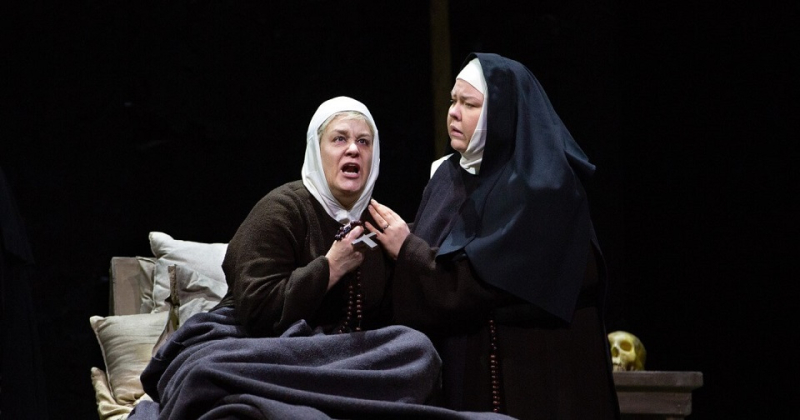
    Coote barton

    Above: Alice Coote as Madame de Croissy and Jamie Barton as Mère Marie; photo by Marty Sohl

    During the pandemic, I often turned to YouTube to keep music vividly in my life whilst live performances ceased, and I came upon a film of Alice Coote singing Mahler’s “Ich bin der welt abhanden gekommen” which moved so deeply. Watch and listen here.

    Today, as Madame de Croissy, Ms. Coote held the House under a spell as the character’s horrific death scene was played out. For a woman whose faith was always deep and seemingly unshakable, the Old Prioress finds herself terrified as she faces her end, wracked with pain. Ms. Coote, a wonderfully word-conscious singer, made the scene the centerpiece of the performance. Both vocally and dramatically, she was living the role: a riveting singer and personality. Rapturous applause greeted her at her solo bow at the opera’s end.

    Jamie Barton has a perfect role in Mother Marie, and she made a splendid vocal impression. Her wide-ranging voice, from dusky chest tones to searing top notes, was in peak form. She held the stage with authority, and finely captured the character’s desperation and guilt on having been separated from her sisters during their final hours on Earth.

    Devieilhe-Sabine-04[Caroline_Doutre]

    Above: Sabine Devieilhe, photo by Caroline Doutre

    How wonderful to see the French soprano Sabine Devieilhe on the Met stage! Having attended her Weill Hall recital in 2019, I have been hoping to see and hear her again…and now she is here with us. As Sister Constance, the petite and lovely Ms. Devieilhe was ideally cast. Her silvery, shimmering tones gleamed in the House, a contrast to the opera’s deepening darkness and sense of impending doom. In the end, her hope of seeing Blanche again gives her the courage to walk to the guillotine, her lone voice the expression of innocence and human fragility. Then the voice of Blanche is heard: she has stepped from the crowd to join her sisters in death. The two girls have a last moment together before fate overtakes them. Incredibly touching.  

    Goerke barton

    Above: Christine Goerke as Madame Lidoine and Jamie Barton as Mother Marie

    Towering, literally, over the sisterhood, Christine Goerke made a splendid impression as Madame Lidoine. If some of the highest notes did not bloom as one might wish, Ms. Goerke’s presence – and her vocal authority – gave the afternoon its center. Her portrayal, so dignified, so lovingly maternal, so…human…was touching to experience. It is Madame Lidoine who leads the procession to the guillotine, by which time I was already weeping.

    The audience, the quietest and most attentive to have been part of in recent seasons, hailed the singers with great affection and admiration at the end. I felt a desire to go to the stage door, where a large crowd had gathered; I particularly wanted to greet Ms. Coote, Mlle. Devieilhe. and Ms. Gigliotti.

    Carmelites 2-1 jpg

    The French soprano was in a rush, probably to catch a flight, but was very gracious and charming; she told me she is already booked for a return to The Met. Ms. Gigiotti signed my program in a distinctive way, matching her distinctive personality; I thanked her for some unique videos she has made (watch here) and for her past performances in works of Nico Muhly and Sergei Taneyev. Ms. Coote walked briskly thru the crowd; undoubtedly she had someplace she needed be.

    The story of the martyrdom of the Carmelite nuns becomes even more poignant when one realizes that their execution took place just ten days before the end of the Reign of Terror. The women were beatified in 1906; this plaque commemorates their deaths:
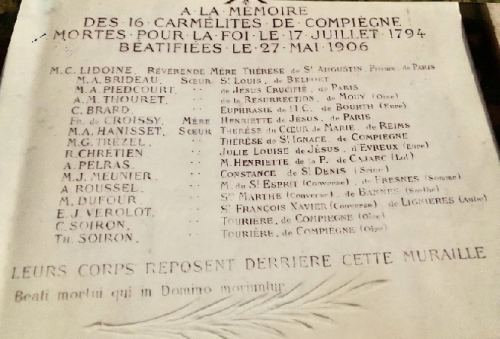
    Carmelites

    It is always difficult to return to the real world after a performance like this; there was so much to ponder after experiencing this opera about man’s inhumanity to man. What harm had these nuns done that merited a death sentence? Why is cruelty so rampant in the history of mankind?  Why do people feel a need to control the beliefs and lifestyles of others?

    ~ Oberon

  • Yuja Wang ~ Rachmaninoff @ Carnegie Hall

    Yuja wang

    Above: pianist Yuja Wang

    Author: Ben Weaver

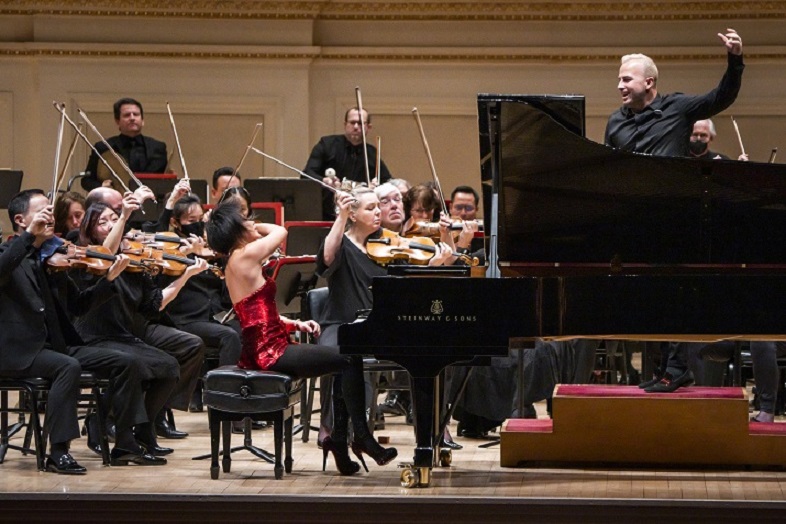
    Saturday January 28th, 2023 – Sergei Rachmaninoff’s four piano concertos are among the most challenging works in any pianist’s repertoire. Today, at Carnegie Hall, pianist Yuja Wang raised the bar for her colleagues by playing all four – plus Rhapsody on a Theme of Paganini – in one afternoon, accompanied by the Philadelphia Orchestra under the baton of Yannick Nézet-Séguin. These kinds of Olympic feats are rare; I’ve heard of the complete Beethoven Symphonies being conducted in a single day and Brahms’ two Piano Concertos in one concert, but I’m unaware of a single soloist taking on 5 concertos in one afternoon. Overall, the concert lasted nearly 5 hours, with two intermissions. Carnegie Hall was completely sold out, and, as a testimony to the artists and to the music, no one seems to have left early.

    One unscheduled extended pause was caused by a member of an audience collapsing and, apparently, dying just as the second movement of the 2nd Concerto ended. The man was revived in the hallway before the performance resumed. Maestro Nézet-Séguin informed us before performance of the 3rd Concerto that the gentleman was out of surgery and was expected to make a full recovery. That’s how long the concert lasted: a man died, was brought back to life, and was out of surgery at the 2/3 point of the afternoon!

    The marathon started with Rachmaninoff’s most enduring work and one of the most beloved works in the classical repertoire: the Piano Concerto No. 2 in C minor, Op. 18, composed in 1900-01 after an extended composers’ block Rachmaninoff suffered because of the disastrous premiere of his Symphony No. 1. After seeing a psychiatrist in France – which included hypnosis – Rachmaninoff composed this magnificent, melodic work which decades later would have pop-songs written to its tunes. (Eric Carmen’s “All By Myself” being perhaps the most successful chart-topper.) Ms. Wang’s strong, incisive solo introduction was a preview of the muscled playing that dominated the entire afternoon. She easily produced massive sounds from the Steinway, rising above Rachmaninoff’s dense orchestrations. Even on recordings, the piano sometimes gets lost in the famous melody at the beginning of Second Concerto’s Moderato movement. Not with Wang, who summoned torrents of sound that cut through the orchestra.

    Rachmaninoff was quite fond of the clarinet and wrote a number of magnificent music for it in his works, including in the Adagio sostenuto of this concerto. (The clarinet’s dark hues are also prominently featured in the contemporaneous Symphony No. 2). Clarinetist Ricardo Morales’ playing was invaluable here. I did feel the tempi in the first two movements were perhaps a bit too languorous; momentum seemed to be lost. But (after the performance resumed following the incident with the ill audience member), the closing Allegro scherzando was an exhilarating conclusion.

    Rachmaninoff’s Piano Concerto No. 1 in F-sharp minor, Op. 1 (composed 1890-91 and revised extensively in 1917) and Piano Concerto No. 4 in G minor, Op. 40 (composed in the US in 1924-26, and premiered by the composer with Leopold Stokowski and the Philadelphia Orchestra) are his least known concertos. Perhaps their melodies are not as hummable as the other works, but they are filled with melodies nonetheless, and wonderful writing for the piano. Ms. Wang met every obstacle with ease and bravura. Concerto No. 1, composed when Rachmaninoff was only 17, has all the trademarks that would define his style as he matured, including expansive, romantic melodies and dark orchestrations. And though Rachmaninoff always maintained that he was a romantic composer through-and-through (and was criticized for it by the modernists), his Concerto No. 4 sometimes echoes – intentionally or not – Ravel’s Piano Concerto and Gershwin’s Rhapsody in Blue (which Rachmaninoff heard at its 1924 world premiere performance.) So while he never became a modernist, Rachmaninoff was certainly influenced by the sounds of his contemporaries. I’ve heard Ms. Wang play a magnificent Ravel Piano Concerto live, and I was getting flashes of some of those moments as she played the Fourth here.

    The Rhapsody on a Theme of Paganini, Op. 43, composed in 1934 and premiered by the composer with Stokowski again conducting the Philadelphia Orchestra, is one of Rachmaninoff’s most brilliant works. Using the same Paganini Caprice that inspired numerous others to compose variations (Schumann, Brahms (two separate works), Liszt, Lutosławski, Schnittke), Rachmaninoff’s compact work never flags. It is a magnificent, tenacious bulldozer of invention. The original tune is shaped, reshaped, stretched in every imaginable way, and yet each variations is a beautiful thing of its own. The most famous of these, the immortal 18th Variation, is the original melody played upside down. The joy maestro Nézet-Séguin took in conducting of this section was clear: he seemed to be floating off the podium. Ms. Wang – needless to say conquered every technical challenge – but also the poetry, the beauty of her playing was unmatched.

    The concert ended with the Mount Everest of the concerto repertoire, the towering Piano Concerto No. 3 in D minor, Op. 30. Composed in 1909, while Rachmaninoff still lived in Russia, he intended it to be his calling card in the West, as he was embarking on his first American tour. And so the concerto was premiered in New York with the New York Symphony Orchestra, conducted by Walter Damrosch. (Six weeks later Raxhmaninoff played it again in New York, this time with the New York Philharmonic- the two orchestras later merged into one – under the baton of Gustav Mahler. There are stories that Mahler was not entirely happy with the collaboration.)

    I don’t know if this concerto actually drove David Helfgott to madness, but it is certainly enough to scare anyone into an asylum, and for Ms. Wang, playing it after roughly 4 hours of performing, was a brave decision. Fortunately for us her hands seem to be made of steel. This was not an example of someone crawling across the finish line: Ms. Wang crossed it at full speed. I noticed her hanging her hands down between playing, seemingly resting/stretching. But her playing did not show any sign of fatigue. Every note was crystal clear, and she – and Maestro Nézet-Séguin – did not shy away from the grandness and romanticism of Rachmaninoff’s music. And there is no better orchestra to play Rachmaninoff than his own favorite Philadelphians. They have this in their blood.

    One thing Yuja Wang is known for – outside of her extraordinary pianism – is outfits (she wore 5, one new ensemble for each work), but another is encores. She is very generous with encores: as long as the public wants more, she is happy to provide. I joked to a friend that really this concert was just a performance of the Second Concerto followed by encores of the rest of Rachmaninoff’s concertos. In the end – after such a grueling afternoon – she gave just one encore, an achingly beautiful “Dance of the Blessed Spirits” from Gluck’s Orfeo ed Euridice, transcribed by Giovanni Sgambati.

    There is so much to admire in Yuja Wang’s artistry. Some people seem to be distracted by her showmanship and outfits. I’m struck by her genuine love of performing live and love for her audience. It’s why she’s so happy to keep playing encores as long as her audience is on their feet. Another great pianist I recently saw live at Carnegie, after an extraordinary concert, offered an encore of just literally a few notes (something by Schoenberg.) Really, it was a joke, but it was also rude. Ms. Wang’s joy at being on stage is infectious. We’ve read about Liszt and Paganini’s shenanigans. Why can’t a contemporary artist do more than roll out, play, and leave? Brava, Ms. Wang, for treating this music as a living, breathing being and engaging with your audience with such generosity.

    ~ Ben Weaver

    Here’s a gallery of performance images by photographer Chris Lee documenting this unique evening:

    CH11298876

    CH11304127

    CH11304129

    CH11304132

    CH11304130

    CH11298873

    CH11298875

    Above: Maestro and soloist at the close of the evening; performance photos by Chris Lee, courtesy of Carnegie Hall

  • Ronnita Miller

    Ronnita Miller

    Above: mezzo-soprano Ronnita Miller; photo by Fadi Kheir

    I was bowled over by Ronnita Miller’s singing as the 1st Norn in Wagner’s GOTTERDAMMERUNG at The Met in 2019. Soon I’ll have a chance to see Ms. Miller onstage again: she will sing the role of Gaea in a concert performance of Richard Strauss’s DAPHNE with the American Symphony Orchestra at Carnegie Hall on March 23, 2023. Details here.

    Sample Ms. Miller’s singing here.

  • Consolation

    Consolation

    Alim Beisembayev, winner of the 2021 Leeds International Piano Competition, plays Franz Liszt’s Consolation III. The young pianist was born in Kazakhstan and trained primarily in the UK.

    Watch and listen here.