Category: Dance

  • Dual-ing Pianos @ Juilliard’s Paul Hall

    Steinway_piano

    Thursday September 26th, 2013 – Students and faculty members from Juilliard’s Collaborative Piano Department joined forces in a really enjoyable concert at Paul Hall tonight. The Department’s pianists had decided that, in addition to playing for singers and instrumentalists, they wanted to work together on music written for two pianos or piano four-hands. They gave their first programme last season and tonight theye were back for Round Two.

    Paul Hall is a special place for me. Having attended a few concerts there on my visits from Hartford many years ago, I started going frequently once I had moved the NYC in 1998. It was at Paul Hall that I first heard my remarkable contralto-friend Makiko Narumi as well as many other Juiliard singers who have gone on to successful careers. Following Makiko’s untimely death in 2002, I found it difficult to sit in Paul Hall, for all the memories the place stirred up. I mostly stopped attending performances there, and it wasn’t until May 2012 that I felt comfortable in the space again: a superb all-Britten programme evening with tenor Spencer Lang and pianist Dan Kurland seemed – in an odd way – a benediction to my friendship with Makiko; she would not have wanted me mourning her ten years after the fact.

    It was in fact Dan Kurland who told me about tonight’s Dual-ing Pianos programme. I’ve never seen such a big crowd in Paul Hall before; I sat in my customary seat – third row on the aisle – and thoroughly enjoyed every moment of this excellent presentation.

    Music spanning two centuries – from Mozart to Lutoslawski – was performed. After brief opening remarks from the head of the Collaborative Piano Department, Jonathan Feldman, the music commenced and rolled onward for 75 minutes without interruption; seven pieces were performed, nicely placed on the programme to emphasize the contrasting styles of the composers. The audience were attentive and appreciative, and the sound coming from the two Steinways was rich and evocative.

    Aaron Copland’s EL SALON MEXICO in a two-piano arrangement was played by Kristen Doering and Art Williford. Bright fanfares evolve into a swaying dancelike passage; a big rhythmic section melts into a gentle romanza which leads to another animated section. The fanfares return, and there is a motif of almost childish naïveté before the boisterous conclusion. This arrangement – and indeed every piece on the programme – would make an excellent dancework.

    Mozart’s Fugue for Two Pianos in C minor was performed by Margo Garrett and Jonathan Feldman, both of the Juilliard Faculty. Evoking  Bach, the work was wonderfully pleasing to experience in this intimate setting. I was very curious about Ms. Garrett’s score, which had an charming binder and in which the music seemed to appear in columns rather than full pages. 

    Darius Milhaud’s Scaramouche suite received a colourful performance by Juliana Han and Jung A Bang. The opening movement, Vif, has an almost music-hall quality; the second, Modéré, begins with a ‘classic’ feel which gives way to a rather wistful melody. In the concluding Brazileira – a full-tilt Latin dance number – the two girls played with enormous vitality.

    Robert Schumann’s Andante and Variations brought forth pianists Luis Ortiz and Miles Fellenberg, playing beautifully. The variations flow like the unwinding of a silken ribbon of melody, with the shifting rhythms and colours playing on our emotions; the final dreamy passage was particularly lovely.

    In Witold Lutoslawski’s Paganini Variations, the familiar strand of melody was marvelously corrupted by the 20th-century Polish composer, giving the music an off-kilter and nightmarish quality. Pianists Siyi Fang and Ari Livne did a brilliant job with this darkly luminous piece.

    Brian Zeger is a pianist I have long admired; tonight he and Bretton Brown played the evening’s only work for piano-hands – and the last work Franz Schubert composed in that genre: the Rondo in A major, D 951. Their playing had great clarity and purity of expression and was a highlight of the programe.

    The evening came to a conclusion with four pianists playing CARMEN Fantasy, arranged by Mack Wilberg. Dan Kurland and Raymond Wong were at one Steinway, Jung A Band and Zsolt Balogh at the other. This wild and wonderful piece draws on familiar themes from Georges Bizet’s opera: the Toreodor Song, the Habanera, the Act II prelude, and Carmen’s ‘Chanson Boheme’. Relentlessly paced and filled with cunning dissonances, this could be the soundtrack for a Hollywood horror film (Micaela’s Nightmare?). It brought the concert to a rousing conclusion, and had me humming the ‘Chanson Boheme’ all the way home on the A train.

  • A Balanchine Evening @ NYC Ballet

    Mourka & mr b

    Above: Mr. B with Mourka

    Wednesday September 25th, 2013 – This evening’s all-Balanchine programme at New York City Ballet was a veritable parade of favorite dancers. The audience, at least in my immediate vicinity, seemed comprised of long-time NYCBers; in fact I seemed to be at the lower end of the age spectrum. It was an attentive crowd, though rather subdued in terms of expressing enthusiasm.

    Any evening that begins with Faye Arthurs onstage is off to a beautiful start; the ballerina – partnered by Zachary Catazaro – danced the opening theme of Balanchine FOUR TEMPERAMENTS. This ballet is for me the most spectacular of the Balanchine black-and-whites, not only because of its marvelous steps and structuring, but the Hindemith score seems to me a true 20th century masterpiece. 

    Lauren King and Allen Peiffer (who literally danced all night) took the second theme, crossing the stage with semaphoric gestures; the melodic sway of the third theme brought forth yet another impressive partnership: Ashley Laracey and Justin Peck. All three couples danced to perfection.

    Robert Fairchild’s Melancholic had a restless grandeur about it: what a compelling stage presence! Meagan Mann and Georgina Pazcoguin circled the handsome danseur, deploying their extensions to dramatic effect. Tyler Angle replaced his brother Jared in the Sanguinic pas de deux; I do not recall having previously seen Tyler paired with Savannah Lowery but it turned out to be an interesting match-up, with Tyler bringing a touch of classic nobility which dovetailed with Savannah’s authoritative contemporary style. In Phlegmatic, Adrian Danchig-Waring seemed to have descended from Mount Olympus: his striking physique and intense focus were engrossing. Ashley Bouder gave a stunning Choleric, her dancing – vivid and grandly secure – was marked by sustained balances and a rich feeling of commitment. In the pit, guest conductor Carolyn Kuan led this splendid score with passionate élan, and pianist Cameron Grant made a significant contrbution to the ballet’s atmosphere.

    EPISODES is basically a series of four duets, three of them performed with attendant corps dancers. Clothilde Otranto and the NYCB musicians gave clarity to the quirky Webern pieces which comprise the ballet’s score, ending with the composer’s imaginative tribute to Bach in a setting from Musical Offering.

    Abi Stafford and Sean Suozzi were finely-matched in the ballet’s opening Symphony; their articulation of the steps and their fluent work as partners made me wish to see them together in other ballets. Three couples echo the principal pair: Marika Anderson with Russell Janzen, Gwyneth Muller with Allen Peiffer and Gretchen Smith with Andrew Scordato. This entire opening movement, with the stage bathed in an unusual verdigris hue, was absorbing to watch.

    Things then take a darker turn as Teresa Reichlen and Ask LaCour appear in pools of light and dance a mysterious succession of five brief duets, their relationship physical but unfathomable. The ballet’s sense of mystery extends to the ethereal Janie Taylor’s appearance in Concerto; dancing with Sebastien Marcovici (who is just back from a hiatus), Janie retains the allure of being the Company’s most enigmatic ballerina.

    EPISODES ends with a gorgeous ritual: a corps of fourteen female acolytes weave patterns around the central couple: Maria Kowroski-  looking supremely divine – and her noble consort Jonathan Stafford. The two principal dancers, so well matched both in physique and in their ability to make expressive nuances count in these abstract ballets, were superb.   

    Principal ballerina Megan Fairchild talks about Balanchine’s DUO CONCERTANT here. When Chase Finlay sustained an injury onstage last week, forcing him to withdraw from his immediate-future performances, I wondered who might partner Ms. Fairchild in this evening’s performance. My thoughts ran to Jared Angle, who had danced DUO so perfectly at Yvonne Borree’s farewell. And sure enough: Jared it was, stepping into the ballet tonight with his signature nobility of style and peerless partnering abilities.

    Kurt Nikkanen and Cameron Grant performed this panoramic Stravinsky score – it veers from playful to deeply expressive – with impressive musicianship. The ballet is an ideal vehicle for Megan Fairchild, sweeping her from girlish impetuosity to womanly tenderness on the brilliant changing modes of the rhythms and harmonies of the instrumental voices. Jared was by turns playful, protective and poignant as he interacted with his ballerina; their partnership was a rewarding one to experience, and the audience – heretofore rather reserved in their reactions to the evening – greeted the dancers and musicians with warm applause. Now I’m wanting to see the Megan/Jared duo in other ballets.

    From its iconic opening diagonal of sleekly white-clad, pony-tailed ballerinas to the final ritualistic tableau as the dancers kneel or raise their arms (in homage to Balanchine and Stravinsky, I imagine) SYMPHONY IN THREE MOVEMENTS is one of NYCB‘s treasures. Excellent demi- and corps work in tonight’s performance, which opened with the vitality of Daniel Ulbricht’s remarkable high leaps; Ana Sophia Scheller, letting her hair down, shows us that a first-class tutu-and-tiara ballerina can also be a dynamic contemporary stylist. Rebecca Krohn looked stunning in her deep-rose leotard and danced with abandon, matched by Andrew Veyette’s speed and clarity. In the central pas de deux, one of Balanchine’s more effective, Sterling Hyltin and Amar Ramasar were at their finest. Earlier, Sterling had made a swift trajectory, circling the stagetwice in pique turns at ever-increasing speed. Amar’s charismatic presence, his commancing partnering and his generosity as a dancer make him an invaluable member of this troupe.

    As the work soared forward to its energetic conclusion, propelled by Carolyn Kuan’s baton, one felt yet again the great genius of Balanchine, and the continuing pleasure of experiencing his works, year after year.

    THE FOUR TEMPERAMENTS: Arthurs, Catazaro, King, Peiffer, Laracey, J.Peck, R. Fairchild, Lowery, T. Angle, Danchig-Waring, Bouder

    EPISODES: A. Stafford, Suozzi, Reichlen, laCour, Taylor, Marcovici, Kowroski, J.Stafford
     
    DUO CONCERTANT: M. Fairchild, J Angle
    SYMPHONY IN THREE MOVEMENTS: Hyltin, Scheller, Krohn, Ramasar, Ulbricht, Veyette

  • John J Zullo/Raw Movement @ St. Mark’s

    Zullo_ExSk_4

    Above: dancer Mike Hodge in John Zullo’s this Exquisite diversion/mysterious Skin

    Thursday September 19, 2013 – John J Zullo Dance/Raw Movement presented three works at St. Mark’s Church In the East Village tonight. An unusual and pleasing dance venue, St. Mark’s sanctuary transforms into a spacious theater-in-the-round. John Zullo’s danceworks function well in this setting, and the evening was enhanced by excellent lighting (Mark Simpson) as well as by the boundless energy of the dancers. The programme featured ALL what THIS do HAS you HAPPENED see? BEFORE, and the world premieres of this Exquisite diversion/mysterious Skin and project Xiii.

    ALL what THIS do HAS you HAPPENED see? BEFORE was the evening’s longest work. The space has been hung with gauzy panels and wrapped in a broad ribbon of white fabric. As the six dancers enter, pacing along the perimeter, they make blatant eye contact with the seated audience members. The dancers then step into a central pool of light and begin to move in silence.

    As the piece progresses in a series of distinct scenes distinguished by the lighting concept, we see movement motifs repeated or rearranged. An animated opening passage in which the dancers rarely touch one another gives way to a broadly lyrical musical theme; solos for each dancer are woven into the movement tapestry. The gossamer fabric-panels are lowered into the dance-space and audience members are ushered into the performing area to observe the dancers at close range. The space is flooded with golden light, and eventually the dancers withdraw from the setting, leaving audience members standing in their places.

    Music for this work includes Monolake, Ludovico Einaudi, David Lynch, and Autechre and the simple costume designs of Hector Perez give the dancers a touch of see-thru allure.  The six dancers – Jenna Liberati, Mary Madsen, Olivia Orozco, Tyler Patterson, Jeff Davis and  Bong Ian Dizon – are all excellent and thoroughly at ease in the physical demands of John Zullo’s choreography. There were passing moments when the work seemed a bit over-long, but the vibrant personal qualities of the individual dancers kept our focus firmly on the movement.

    I’d had a glimpse of the evening’s second work, this Exquisite diversion/mysterious Skin earlier this year at LaMaMa. Inspired in part by Scott Heim’s novel
    “Mysterious Skin,” in which two young boys are sexually exploited and
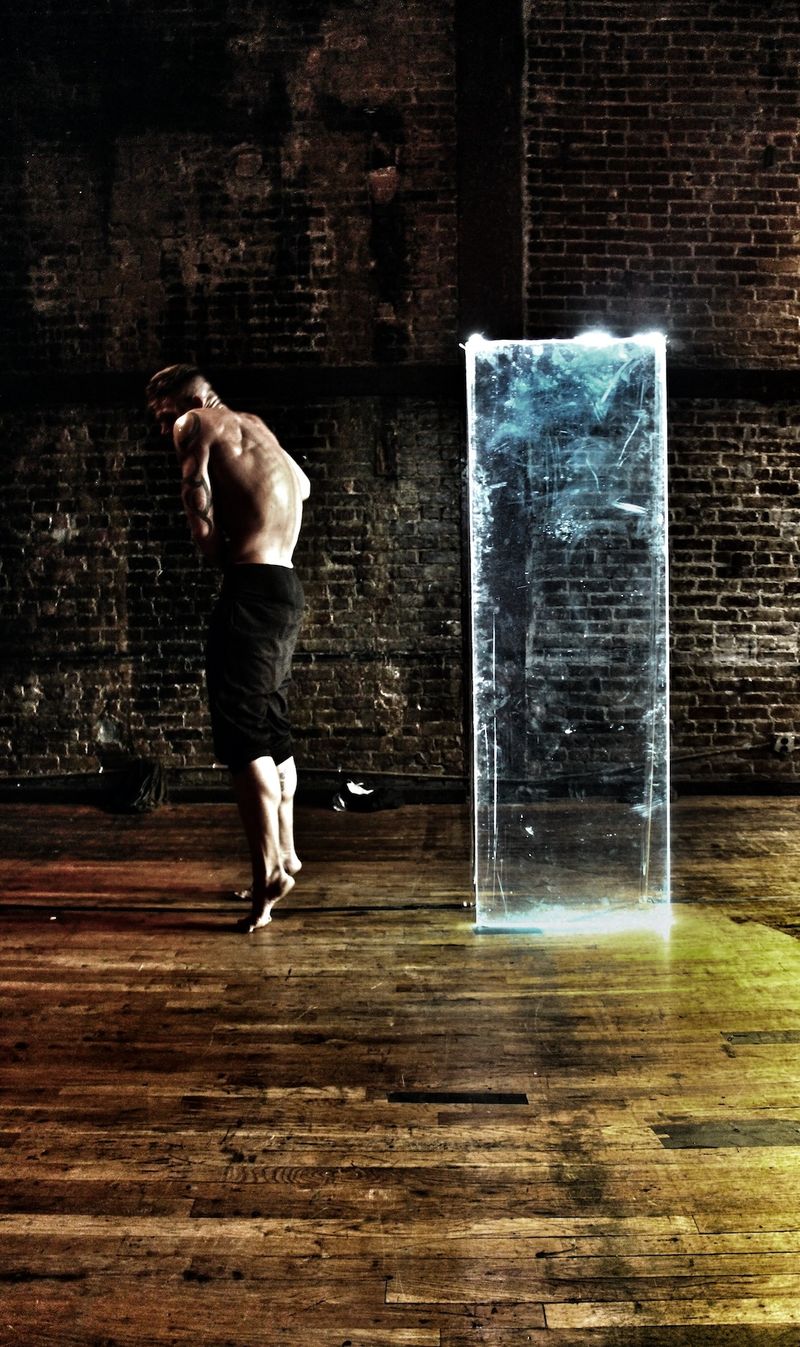
    assaulted, this darkly sensual and provocative dancework is set amidst luminous lucite panels which serve as both mirrors of the dancers involved and windows into their dark doings. The collage-score, arranged by David Englehard, includes Olafur Arnalds, Max Richter, and Deru; and at one point singer Jessie Davis wanders into the space singing “Dream A Little Dream of Me”.

    L1220636

    Tyler Patterson (rehearsal photo, above) opens this Exquisite diversion/mysterious Skin with a restless, floor-oriented solo. Later, stripped down to black briefs, Tyler’s beautiful vulnerability became a poignant element of the work. The shadow effects, off-setting the radiance of the lighted mirrorlike-panesl, create a haunting visual landscape. Jenna Liberati, Olivia Orozco, Jeff Davis, Bong Dizon, and Mike Hodge are the other fine dancers in this unsettling, brink-of-a-nightmare work.     

    project Xiii begins with a digital clock in the center of the space being set for a 13-minute countdown. The piece commences with John Zullo dancing the first of twelve solos, each to music chosen by the various dancers. Guest artists mingle with Company members, each dancer having 60 seconds to work their self-made phrase. This imaginative piece had the benefit of Mark Simpson’s lighting; Mark’s contributions to the evening were underscored here as Jenna Liberati, in a pool of light just a couple feet away from me, danced with her own shadow. This piece was an excellent way to end the evening.

  • Tom Gold Dance @ Bilbao

    TOM GOLD DANCE  Apollo with   Sara Mearns,  Adrian Danchig Waring, Abi Stafford

    On August 21st and 22nd, 2013 Tom Gold Dance performed at the Guggenheim Museum at Bilbao, Spain. The programme consisted of Tom’s ballet LA PLAGE, Balanchine’s APOLLO, Jerome Robbins’ CONCERTINO, and the pas de deux from FLOWER FESTIVAL AT GENZANO. In the top photo, Sara Mearns, Likolani Brown, Adrian Danchig-Waring and Abi Stafford in APOLLO.
    Click on each photo to enlarge.

    TOM GOLD DANCE   Flower Festival at Genzano  with  Devin Alberda and Abi Stafford

    Above: Devin Alberda and Abi Stafford in the FLOWER FESTIVAL pas de deux.

    TOM GOLD DANCE  Concertino, with  Stephen Hanna, Sara Mearns, Andrew Scordato

    Above: Stephen Hanna, Sara Mearns and Andrew Scordato in CONCERTINO.

    These images from the performance are courtesy of The Guggenheim Museum, Bilbao.

  • In the Studio with Miro Magloire

    L1200876

    Above: Holly Curran and Traci Finch rehearsing for New Chamber Ballet

    Wednesday August 28th, 2013 – Miro Magloire, always one of the busiest people on the New York City dance scene, is busier than ever these days. Not only is he preparing for the upcoming performances of his New Chamber Ballet (September 6th & 7th at City Center Studios) but he is also creating five new works for the Austrian Cultural Forum’s Moving Sounds Festival for a performance on September 20th, as well as looking ahead to New Chamber Ballet‘s tour to Germany.

    For the Moving Sounds Festival, New Chamber Ballet will team up with
    the Argento Chamber Ensemble for a program of five new ballets – and a
    revival – to music by contemporary Austrian and American composers. A world premiere collaboration with
    composer Michel Galante, a new work to a new score by composer Nina C.
    Young, and new creations to scores by Beat Furrer, Georg Friedrich Haas,
    and Arthur Kampela will be featured. The program – which will also include a revival of Miro’s ECHOES to music by Anton Webern – takes place at the Bohemian National Hall, Czech Center, 321 East 73rd Street, NYC on September 20th. Visit the Festival’s page here.

    I stopped in at Ballet Hispanico today where Miro and his dancers – Elizabeth Brown, Sarah Atkins, Holly Curran, Amber Neff and Traci Finch – were working on some of the new rep. Composer Nina C Young dropped by to see the piece Miro is creating to her score.

    Here are some photos I took of the new works in rehearsal:

    L1200839

    Ellizabeth Brown and Amber Neff

    L1200709

    Traci Finch and Holly Curran

    L1200794

    Amber Neff

    L1200807

    Elizabeth Brown

    L1200932

    Holly Curran, Amber Neff

    The final half-hour of the rehearsal time was devoted to Amber Neff working on the solo IN A SIMPLE BLACK DRESS, one of my favorites among Miro’s ever-expanding repertoire of intimate ballets. Here are some images of Amber rehearsing this solo:

    L1200988

    L1210107

    L1210054

    L1210147

    L1210189

  • In the Studio with Kensaku Shinohara

     L1200504

    Click on the image to enlarge.

    Wednesday August 28, 2013 – I stopped by at Far Space today where dancer/choreographer Kensaku Shinohara was rehearsing a work for four dancers that he’ll be presenting on September 29th, 2013 at the Dumbo Arts Festival. Performance detail here.

    Currently titled MATH TIME, the evolving work will most ilkely have a new name – possibly 1000 DESIGNS – by the time of the Festival performances. The piece was shown at Bryant Park in early August, so it is structurally completed; today Kensaku and his dancers were working on fine-tuning and nuances.

    Here are some images from the rehearsal:

    L1200423

    Ellyn Sjoquist and Lynda Senisi

    L1200469

    Lynda Senisi, Damani Pompey and Ellyn Sjoquist

    L1200476

    Ellyn

    L1200509

    Jake and Damani

    L1200433

    Kensaku, Jake and Damani discuss the fine points

    L1200618

    Jake Bone, Damani Pompey

    L1200653

    Lynda, Ellyn, Jake


    L1200471

  • The Current Sessions: Volume III Issue II

    ND4_6750

    Above: singer/composer Julie Hill (background) and dancers Chloe Felesina and Ian Hussey in Colby Damon’s Let me Live. Photo by Corey Melton.

    Saturday August 24th, 2013Down to The Wild Project, an intimate venue in the East Village, for the latest installment of the Current Sessions, a series of performances featuring the work of contemporary choreographers of the Now and Next generations. With mix-it-up programming, each evening in the run produces a unique experience. Allison Jones and Alexis Convento are the co-founders of this ongoing project, and they’ve put their stamp on the series which started in 2011 and continues to hold a unique place on the New York City dance map.

    ND4_6919

    Colby Damon
’s Let me Live (above photo) opened the evening impressively, with a string quintet playing Julie Hill‘s evocative score live onstage. Ms. Hill’s plaintive, unamplified singing wove thru the shiningly lyrical textures of the strings; her natural voice lent an air of vulnerability to the piece. Dancers Chloe Felesina and Ian Hussey performed Colby’s pas de deux with perfect expressiveness; their complex relationship veers from tenderness to traces of violence. In its unity of music, movement and mood this piece made a strong impact.

    Roya Carreras’ A Table is an intimate domestic drama performed by Ms. Carreras, Leslie Curtis and Alexandria Yajl. “I remember but not every time, never is order” describes the state of a woman,  perhaps in the stages of Alzeheimer’s, struggling with daily tasks while an attendant couple – perhaps real, perhaps imagined – inhabit her world to mysterious effect. Stylized movement and a layered score construct the situation, giving way to a melodious rhythmic solo (danced with one shoe off) a l’Espagnole. A lemon and some potted marigolds come into the scenario. An air of hopelessness seems to seep in, and a feeling of long days and unresolved, thwarted emotions. The individual performances of the three dancers were strong and moving.

    ND4_7545

    Above: from dyad

    Allison Jones and Hayley Jones took the stage for dyad, a fantastic duet in which the two girls – in ‘nude’ tops – danced in stylized and often synchronized moves to a Sam Silver soundscape. Sam Hart’s projections of both kozmic abstractions and glowing solid colours gave the dance its electric setting, while the intense shadows cast by the two dancers added a striking visual dimension. The piece is vivid, the dancing hi-energy and exciting to watch.

    ND4_7989

    Two of Gotham’s smoothest movers – Christopher Ralph and Daisuke Omiya (photo above) – performed Gregory Dolbashian’s witty duet Go H.A.M. The boys have just started getting their groove on when the music halts, freezing them in ballet poses. They start again, but it keeps happening. After several thwarted attempts to do their own thing, Dai and Chris surrender to Mozart (the opening duet from NOZZE DI FIGARO) and carry on their competition in a fusion style. The crowd loved the piece and the two boys who danced it.

    Charli Brissey made a fine impression with her engaging mixture of naturalness and quirkiness in a solo work-in-progress Human Friend, described as “….an experimental embodiment of queer animalism and social awkwardness.” The dancer effortlessly held the stage with her gamine physique and quiet intensity; eye contact with her viewers kept us in firm focus as the work unfolded.

    Hayley Jones returned for the final piece, LoudHound Movement’s A Sentinel Without Lips. Hayley was joined by Kacie Bobitt and Sarah Stanley in this darkish, unsettling work which is planned as part of an upcoming installation. Synchronized duets and intense solos mirror the mind-states of the three women; their humming casts an eerie quality into the soundscape, and again shadows on the wall play a part in the works overall mystique. Allusions to eating disorders and a sense of despair are present, and so is an offbeat lyricism that keeps us engaged. Again – as all evening – the dancers excelled.

    All performance photography by Corey Melton.

    The Wild Project is a great space, and I loved running into some danceworld friends: aside from Allison and Alexis, Giorgio Bovo, Elise Ritzel, Colby Damon, Gregory Dolbashian and Bennyroyce Royon were all  out on this refreshingly cool summer’s eve.

  • US Open Qualifying Tournament 2013 #3

    L1200157

    Above: Victoria Duval of the USA

    Friday August 23, 2013 – A beautiful day at the US Open qualifiers, marred only by an on-court temper tantrum from Canadian Frank Dancevic. The sky grew overcast as the day went on, but no rain fell and there was a nice afternoon breeze…ideal conditions both for playing and watching.

    L1200137

    I started off at Court 17 watching – for a change – a women’s match. America’s Victoria Duval (above) gave an impressive display of her talents in a fast-moving match against Croatia’s Tereza Mrdeza. Victoria pretty much dominated throughout; Tereza managed to get her foot in the door, and she pulled off some nice shots; but she just didn’t have the weaponry to respond to Victoria’s steady onslaught. I love Court 17 by the way: the new and oddly cozy stadium-style court.

    L1200193

    Above: Maximo Gonzalez of Argentina threw a monkey-wrench into Amir Weintraub’s hopes for a win today; the crowd was very much behind the Israeli but the crafty Argentine seemed to have a sharp overall game plus the passion needed to overcome his taller and – perhaps – more polished opponent. 

    L1200302

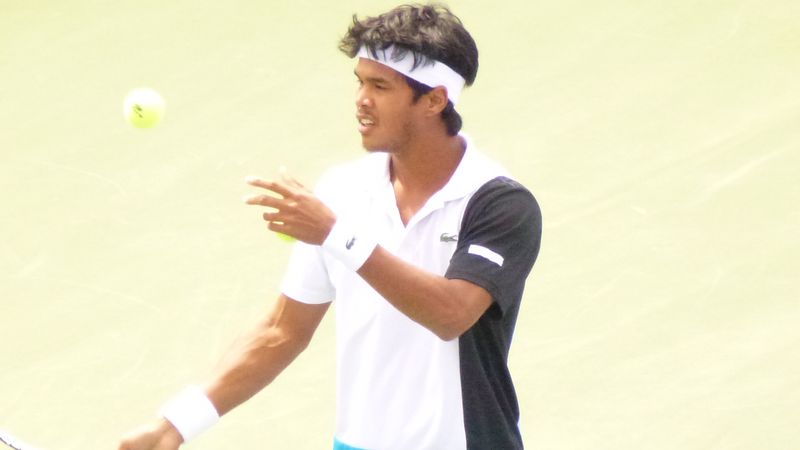
    Above: Somdev Devvarman of India had to overcome a very strong showing by Britain’s James Ward. Ward pulled off some impressive shots; after Somdev won the first set the Englishman took control and evened things up. It looked like it could go either way, but Somdev’s steady style prevailed. I really like watching him play.

    L1200295

    Above: Somdev Devvarman

    L1200232

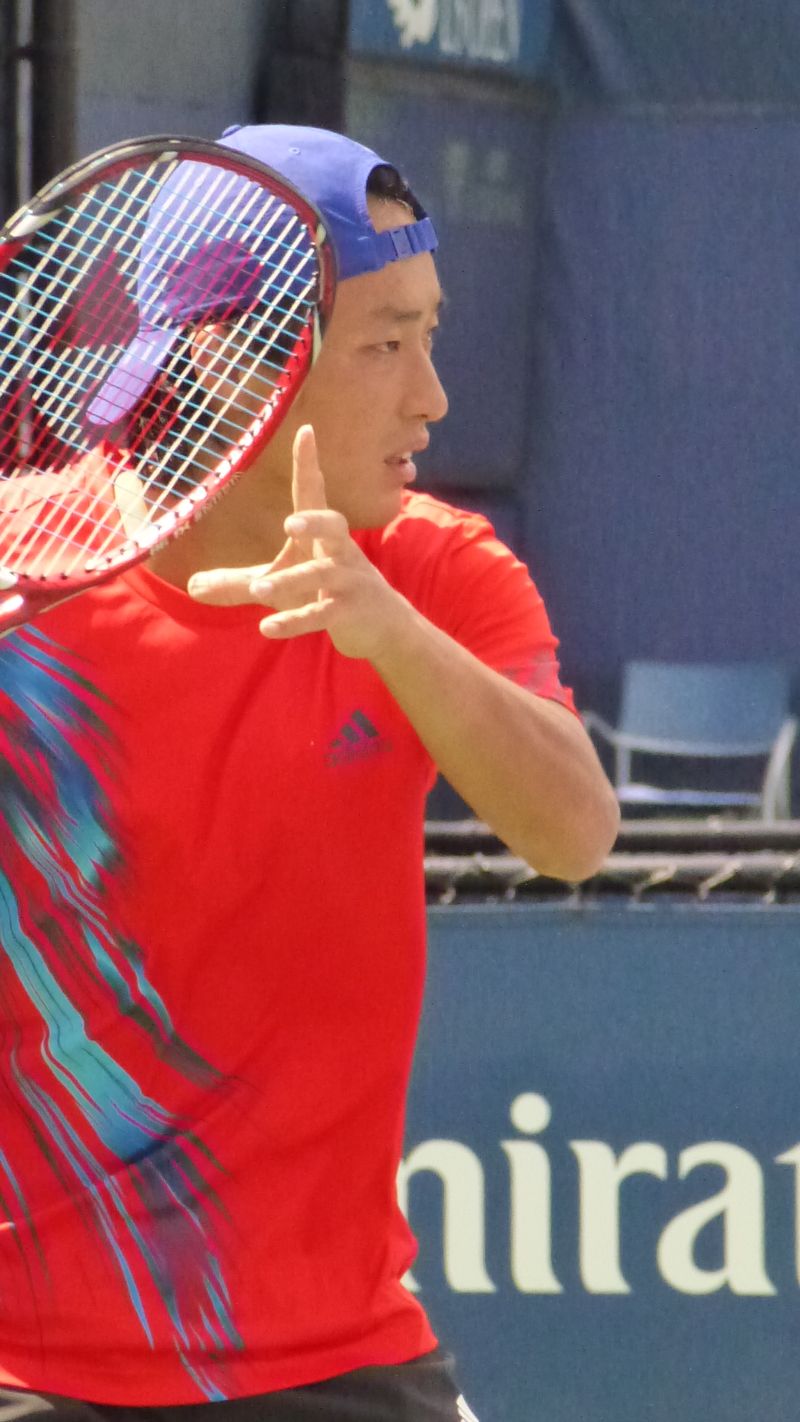
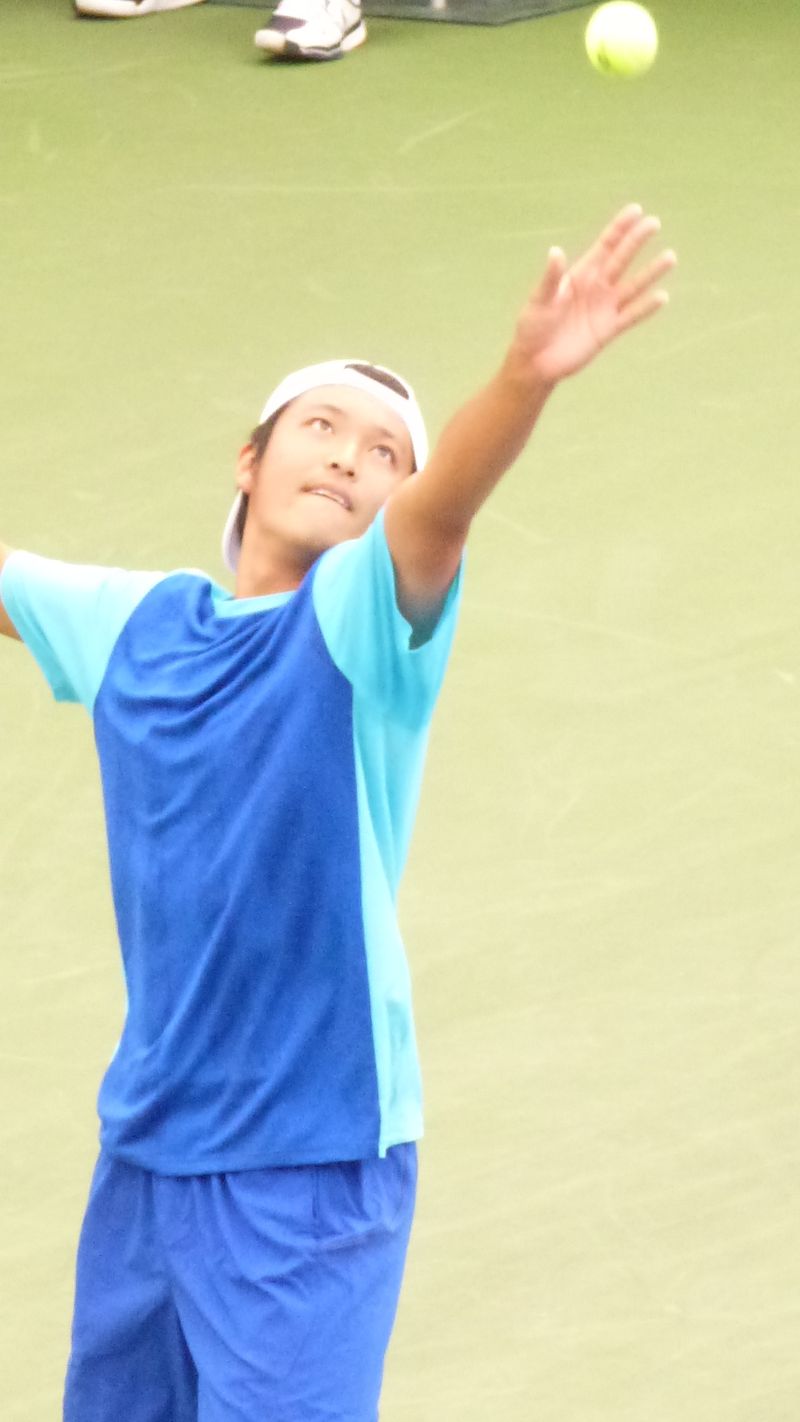
    Above: Go Soeda of Japan; Go’s been a favorite player of mine for several seasons now and today I got to watch him having a practice session and then – later – his match against Jan Hernych of the Czech Republic.

    I like Hernych, he plays a good game and it didn’t surprise me that he took the first set, following an extended tie-breaker.

    L1200338

    Then Go dug in and persevered thru two more hard-fought sets. The crowd was pro-Go all the way and  there was an air of celebration when the Japanese secured the win.

    L1200395

    Go Soeda after the match

    L1200376

    Japan’s Tatsuma Ito (above) took the first set of his match against Frank Dancevic. Ito plays beautfully, strong and steady. Dancevic took the second set. Throughout the first two sets, Dancevic threw minor hissy-fits whenever he felt he’d gotten a bad call. But in the third set he staged a full mad scene, halting play completely while he debated with the chair umpire at length as Ito stood waiting patiently at his end of the court. The crowd finally gave Dancevic a much-deserved round of booing; in my view he should have been fined a point for delaying play.

    Dancevic finally resumed playing and eventually he won the match, but his behavior was inexcusable. Everyone gets bad calls…and I hate to tell you this, Frank, but I watched a couple of your shots go long today and they weren’t called out. Poor sportsmanship leaves such a sour taste; I’ll never want to see another Dancevic match. He may have won today, but Ito is the classier player.

  • ABARUKAS + vivake @ MMAC

    1069802_10151735363464933_471183311_n

    Sunday August 18, 2013 – One of my few opportunities to try a new dance company, since their performance happened to fall on one of my rare free days: Abarakus Contemporary Dance Company gave two performances at MMAC this weekend where they were joined by the hip-hop company vivake.

    vivake opened the show, dancing Scar. The Company, led by Vivake Khamsingsavath, is made up of sexy boys and beautful girls, and they danced up a sultry summer storm in this darkly alluring piece. All clad in black, and illuminated by the fine lighting design by David Opara, the dancers exuded sensuous energy. Vivake himself is an ultra-charismatic personage, a dancer who put me very much in mind of such super-smooth Gotham movers as Bennyroyce Royon and Norbert de la Cruz. I look forward to seeing this dynamic group again.

    I loved looking at the cast listings this evening and finding familiar names: Lizzy Zevallos dancing with vivake and Guang-Lei Hui dancing with ABARUKAS. I really enjoyed seeing both of them again.
    ABARUKAS offered Yoshito Sakuraba’s “Lullaby to Mr. Adam“; this note from the choreographer had me expectng a narrative dancework:

    Lullaby
    to Mr. Adam
    emerges from from an idea of a complete separation from
    reality, imagining myself returning to the past.   I imagine myself
    walking to my home where I lived and loved when I was little.   The
    moment I start imagining that, I continue to recall a letter from the
    first girl I fell in love with, the barbershop I used to go to, streets
    where I’d bicycle to school, a sky where there were fireworks in the
    summer, friends I played basketball with, and my grandma, whom I loved
    but never expressed that to her.  I’ve lived through everything and
    everyone’s memory.   And they lived through mine.   I still have the
    letters from the girl.”

    But the choreographer is not a literalist; the piece is abstract and opens with a ritualistic passage in which we meet the dancers one by one. As with vivake, ABARUKAS is a Company loaded with talent. As individuals and as an ensemble, they danced with vivid commitment. Plenty of solo opportunities were afforded as the dancework unfolded. The choreography is gestural, scupltural, and – again – excellently lit by Mr. Opara. 

    Adan Jiminez Aguillar, a tall and stage-commanding presence, had a central role in the piece commencing with a passage in which he shoots – and then revives – his fellow dancers. He’s cast as a rather tyrannical type, though in the end he manages somehow to redeem himself. Guang-Lei Hui is a very fluid mover and a strong partner, and Shawn Rawls showed some remarkable break-dancing skills in his solo. Adan has a sustained, powerfully lyrical solo danced to the evening’s most poignant musical theme. The women – Caitlin Cantrell, Erin Dillon, Rebecca Quintrell, and Tsai-Hsi Hung – danced beautifully and allowed their individual personalities to emerge as the work surged forward.

    The denouement of the piece comes as each dancer steps forward to slap Adan’s face – he endures this, and expects the same from Guang-Lei who instead gently lays his hand on Adan’s shoulder. A perfect final image as the light fades.

    But no – there’s more to come. Another ensemble passages melds into a spacious duet for the striking Erin Dillon and Adan which ends with yet another ideal final tableau. But no – the work continues on. It’s all well-crafted and very finely executed, but after two false endings things seem to be stretching on a bit too long; a judicious paring down and some re-arranging of the various segments could produce a more cohesive and impressive overall effect. Nevertheless, the performances of the dancers overcame any slight misgivings about the structure of the piece.

  • JANUSPHERE at the IATI Theater

    Janusphere

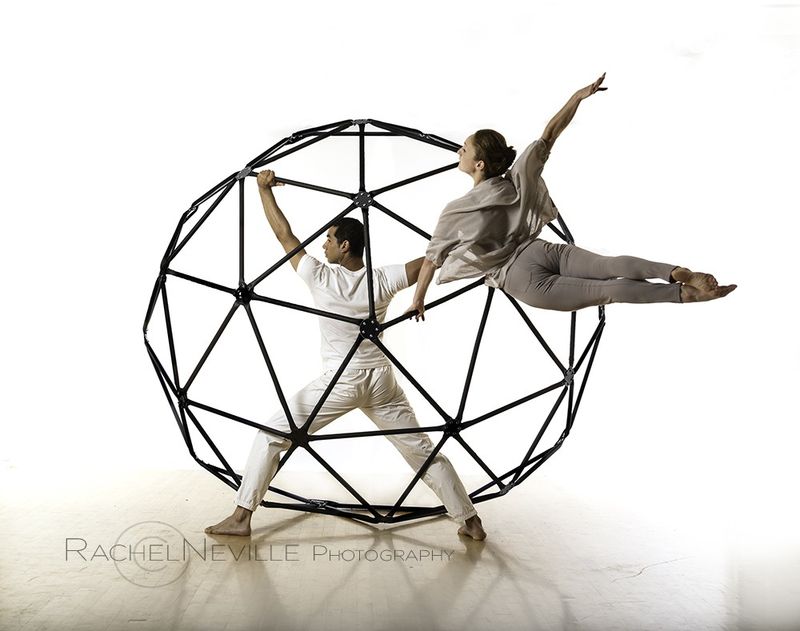
    Photo: Rachel Neville

    Sunday July 28, 2013 – JANUSPHERE at the IATI Theater down on East 4th Street. I met my friend Roberto Villanueva (of BalaSole Dance Company) there on an overcast afternoon.

    Aqura Lacey, Dora Kovac, Grace Song, Jason Jordan, Luke Manley and Matt Van appeared in KinderPlatz (Children’s
    Place
    ) which is set to a darkish, at times almost ominous score by Adyo and Deepbass. Despite its title, there’s nothing juvenile about this work. The dancers,
    clad in soft creamy outfits, perform a series of trios and duets, often changing partners and configurations. They run and slide across the smooth floor, or stand still waving their arms in
    unison windmill patterns; in these motifs the illusions of children’s
    games are expresssed, but the mood remains distinctly ‘adult’.

    A geodesic dome serves as a jungle gym, a cage, a bowl. At one point Ms Lacey climbs up onto the shoulders of the men, as if trying to escape thru the ceiling.  

    KinderPlatz is accompanied by original video projections created by visual artist Aleksandar
    Cosic, featuring elements of architecture and shifting perspectives. What makes the work appealing though is the movement quality and the clarity of personal expression of the six indivdual dancers.

    A Dancer’s Life opens with the diverse group of Janusphere
    dancers appearing one-by-one in practice clothes, telling their stories of “why I became a dancer”. A solemn narrator calls the group to order and they start doing classroom pliés and
    tendus, and working on partnering.

    Then the competitive spirit takes over: to the ‘Lone Ranger’ theme from Rossini’s WILLIAM TELL overture, the dancers race about the space, bumping one another off in an effort to get ahead of the pack. In an audition scene, the dancers vie
    fiercely for available work…and then comes the anguish of waiting for
    a callback. When all but one dancer are called,
    there’s relief and rejoicing, as well as a defensive narrative from the unchosen one. The work ends with the start of another day, another class.

    In A Dancer’s Life, the cast of KinderPlatz are joined by Misei Daimaru, Stephanie van Doreen, and Ashley Whitson. In the theater’s intimate space, the personalities and individual attractiveness of the dancers gave the performance a sense of direct communication.