Category: Music

  • Carol Neblett Has Passed Away

    Snapshot

    One afternoon, while I was working at Tower Records, the phone in the opera room rang. I hated taking phone calls, but it was part of the job. “Is this the opera department?” a woman’s voice asked; I answered in the affirmative. “Are you an opera-lover?” Oh boy, another whack job. “Yes,” I said impatiently. “You might remember me…my name is Carol Neblett.” Relief, and excitement: “Yes, Miss Neblett…I was at your City Opera debut and I remember it like it was yesterday.” “Oh, how sweet of you to say that…!”

    It’s true, too. Her NYCO debut – which was in fact her operatic debut – as Musetta in LA BOHEME in 1969 was simply electrifying. Not only was she a knock-out gorgeous woman with a figure to die for and a mane of rich blonde hair, but the voice was staggeringly large, luminous, and sensuous, with vibrant and blooming top notes. As Musetta, she received three ovations in the course of ten minutes: one after the Waltz, the second after the big ensemble that follows, and the third – so massive I thought the roof might cave in – when she took a solo bow before the curtain.

    Scanned Section 6-1

    I took this photo of Carol Neblett at a Promenade event at New York City Opera where she sang “Depuis le jour” from LOUISE.

    Carol went on to sing numerous performances with New York City Opera, and I well remember her in the dual roles of Margherita/Helen of Troy in the sensational Tito Capobiano production of Boito’s MEFISTOFELE, opposite Norman Treigle’s riveting portrayal of the devil. The ovations at that production’s premiere were epic, and it put the opera back on the map, with NYCO getting a lot of mileage out of it in the ensuing years.

    Scanned Section 9-1

    Above: Carol Neblett in a 1970 photo by Bill Hendrickson

    In 1973, Ms. Neblett was a glamourous Ariadne – both vocally and physically – in NYCO’s 1973 production of ARIADNE AUF NAXOS; this production, sung in English/German and brilliantly performed down to the tiniest roles, made ARIADNE my favorite opera…which it remains to this day. Carol’s Yaroslavna (PRINCE IGOR) and Donna Elvira (DON GIOVANNI) at NYCO were both very finely sung and acted.

    Carol Neblett – Mi tradi ~ DON GIOVANNI – NYCO 1972

    Ms. Neblett made her Met debut in 1979 in Jean-Piere Ponnelle’s much-maligned production of DER FLIEGENDE HOLLANDER. She gave 85 performances with the Company, at Lincoln Center and on tour. I saw her as a very exciting Tosca at a matinee in 1981, opposite Jose Carreras and Sherrill Milnes. She looked striking and sang generously as Amelia in BALLO IN MASCHERA opposite Carlo Bergonzi in 1983. I also saw her on The Met stage as Alice Ford in FALSTAFF and in a tour performance as Donna Elvira in Boston in 1981. 

    Scanned Section 4-1

    Meanwhile, in other parts of the forest, the soprano took on such roles as Turandot, Minnie of the Golden West, Aida, and Norma. Her singing became erratic over time, and she later admitted to alcohol addiction, from which she made a recovery. But her voice remained large and impressive through thick and thin:

    Carol Neblett – Es gibt ein Reich ~ ARIADNE AUF NAXOS – from radio concert

    Carol Neblett – In Questa Reggia ~ TURANDOT – Pittsburgh 1978

    Carol had her fun-loving side, too…here she is on the Johnny Carson Show. The voice is prodigious.

    My final encounter with Carol Neblett in performance came unexpectedly: one morning in October 1992, I was leafing thru the Sunday edition of the Hartford Courant and noticed, purely by chance, that Carol was scheduled to sing a recital at Hartt College that afternoon. On a beautiful Autumn day, I walked for over half-an-hour to the hall, having no idea what to expect.

    Scanned Section 5-1

    Carol appeared onstage, looked older of course, but still mighty attractive. After some Baroque songs, she sang a really beautiful Brahms set, then the Song to the Moon from RUSALKA, and three gorgeously-done Strauss songs. After the intermission, she sang some very lovely Debussy songs, and then gave a powerhouse performance of Chimène’s magnificent aria “Pleurez, pleurez mes yeux” from Massenet’s LE CID. The printed program concluded with some Spanish songs which suited her well. She sang two encores: the “Vissi d’arte” from TOSCA and “If I Loved You“.

    I can’t remember now why I didn’t go to say hello to her after the recital, and I really regret that I didn’t. Over the ensuing years, memories of her cropped up quite often – especially of the glorious Musetta-debut. And then, that day at Tower, the phone rang.

  • Kitty Carlisle

    Scanned Section 17-1

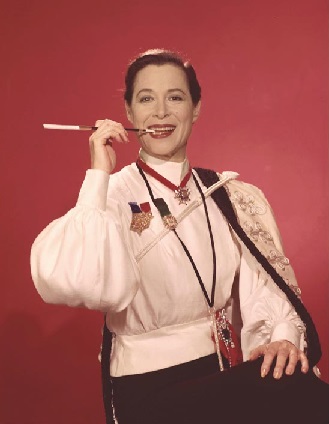
    When I was a kid, everybody knew who Kitty Carlisle was: a panelist on the popular TV game show To Tell The Truth. But I had no idea she was also a singer. Born in New Orleans in 1910, she had studied voice there and subsequently appeared in musicals – and even as Carmen (in Salt Lake City). She made several musically-oriented films, including the Marx Brothers’ A NIGHT AT THE OPERA.

    38b1e7568ea4345712de0e72683ce526-1

    In the summer of 1966, my parents took me for our annual summer vacation to Saratoga where Eugene Ormandy was conducting a concert performance of FLEDERMAUS with the Philadelphia Orchestra. The main attraction for me was the presence of Hilde Gueden, Roberta Peters, and Barry Morell in the cast. Kitty’s being cast as Prince Orlofsky seemed like a gimmick to me, but she actually sang very well. 

    CarlisleFledermaus

    Above: as Prince Orlofsky, in a Louis Melançon/Met Opera portrait

    Later that same year, Kitty Carlisle made her Met debut as Orlofsky. I sent her a congratulatory letter and received the card at the top of this article in return. She sang the role fifteen times with The Met, at Lincoln Center, on tour, and in the Parks Series. In 1980 she appeared in the role for the final time for Beverly Sills’ farewell gala at the New York State Theater. 

    Kitty dated George Gershwin and married Moss Hart. She served for twenty years on the New York State Council on the Arts, and was seen often among audiences at Lincoln Center events. I saw her once, walking alone across The Met lobby: she must have been 80 or so, but her erect posture, jet black hair, and elegant outfit gave her a timeless air. Kitty Carlisle passed away in 2007.

    And yes, she really could sing:

    Kitty Carlisle – Vilja ~ THE MERRY WIDOW

  • Huang|Noseda|New York Philharmonic

    Frank_huang_1684x936

    Above: The New York Philharmonic’s concertmaster Frank Huang

    ~ Author: Oberon

    Wednesday November 22nd, 2017 – The announcement of the death of the great Russian baritone Dmitri Hvorostovsky coloured my entire day. It came, by unhappy coincidence, on the anniversary of the assassination of John F Kennedy which took place in 1963: the most disturbing world-event of my youth. That brutal murder – and its aftermath – I still remember so clearly.

    This evening, I went as planned to  The New York Philharmonic‘s program of Russian and French works. Though I was in the mood for darker, more soul-reaching music, the program – magnificently played – did lift my spirits, if only temporarily.

    As far as I know, Mr. Hvorostovsky appeared with The New York Philharmonic for only one program: in 1998, he sang Mahler’s Kindertotenlieder with the orchestra. I was there, and was swept away by the peerless beauty of his voice and by his deeply poetic interpretation. How I wished he could have been with us again tonight. But the program did commence with music from Hvorostovsky’s homeland: a suite from Nicolai Rimsky-Korsakov’s opera The Legend of the Invisible City of Kitezh. It ended up being my best-loved work of the evening and it was brilliantly delivered by the Philharmonic players, under Gianandrea Noseda’s baton.

    Hearing music from The Legend of the Invisible City of Kitezh brought back memories of a day in 1983 when I stepped off a bus in Boston on a Sunday afternoon and began walking towards the opera house where the Rimsky-Korsakov opera was being performed at a matinee. Suddenly the sky opened up; no store that was open sold umbrellas. I made a run for it, but was literally drenched from head to toe by the time I got to the theatre. Needless to say, I did not enjoy the performance at all, and left at intermission…still soaking wet.

    The suite from The Legend of the Invisible City of Kitezh is in four movements, depicting episodes from the opera: a Hymn to Nature, Fevronia’s wedding procession, the invasion of the Tatars and the subsequent battle, and Fevronia’s Ascension to the Invisible. It begins on a sombre note, with harps adding a touch of magic. Throughout the suite, solo wind passages abound; Maestro Noseda brought out these colouristic facets, and the Philharmonic artists played them delightfully.

    A broad viola theme stands out, and the percussionists are kept on their toes with bells, chimes,and glockenspiel in addition to the timpani, bass, and snare drums that come to attention for the battle scenes. The suite was an excellent program-opener.  

    It’s always a great pleasure when principals from the Philharmonic step into the concerto spotlight. Tonight, concertmaster Frank Huang performed Camille Saint-Saëns’ Violin Concerto No. 3 – my first time hearing it live. The concerto begins without an orchestral introduction; instead, only quiet, darkish chords  provide a background for the rather harsh opening phrases of the violin. Mr. Huang’s playing here seemed a little unsettled, with traces of sharpness of pitch. But within seconds, the violinist had settled into the music and gave a really impressive, technically assured performance.

    As the concerto’s first movement develops, there are dramatic contrasts between full-bodied, passionate themes and more sedate passages. There is a sense of yearning in the music which Mr. Huang conveyed to perfection. In the Andantino which follows, the composer meshes the solo violin with winds in music with an elegant air. 

    The concluding movement begins with a slow introduction and some almost jagged interjections from the  violin. The Allegro non troppo itself is launched with an up-sweeping motif for the solo violin. Passages of coloratura for the soloist alternate with more lyrical elements; then commences a surprising cantabile, where Mr. Huang’s beauty of tone was ravishingly engaging. Pages of virtuosic writing show off the soloist’s fluent technique, and hints of gypsy passion are thrown in. The leaping violin theme returns and is most welcome. An orchestral chorale is an innovative detour before the concerto sails on to a bravura finish. Mr. Huang was rightly accorded a prolonged ovation from the audience whilst his onstage colleagues tapped their bows and stamped their feet in acclaim.

    Noseda

    Above: Gianandrea Noseda

    Rachmaninoff’s Symphony No. 3, under Maestro Noseda’s baton, followed the interval. Like so many symphonic works, its a piece I’m not really familiar with, and I must say, I felt slightly disappointed with it musically. It’s all terribly impressive and enjoyable to hear, but the emotions are rarely engaged. Perhaps it was just my mood, but I kept longing for a deeper experience.

    That said, the artists of the Philharmonic played it most impressively. And it is to them that I owe thanks for moving or thrilling me on this evening: to Mr. Huang of course, but also to other players who had prominent passages tonight: Sheryl Staples (violin), Yoobin Son and Mindy Kaufman (flute/piccolo), Sherry Sylar (oboe), Pascual Martinez Forteza (clarinet), Kim Laskowski (bassoon), and Amy Zaloto (bass clarinet).

    Encouraged by the great success of his Rhapsody on a Theme of Paganini (1934), Rachmaninoff started  work on his third symphony in the summer of 1935. Leopold Stokowski and the Philadelphia Orchestra gave the premiere on November 6, 1936. It was not well-received by the audience, nor by the press. Perhaps, as with those early auditors, I need to hear it a few more times to cultivate a more positive reaction. 

    There are countless appealing passages – a cello tutti was especially beautiful – and the final movement’s journey from optimism thru a vale of doubt and the onward via a meditative passage to a ringing conclusion evoked a big response from the Geffen Hall audience.

    ~ Oberon

  • Dmitri Hvorostovsky Has Passed Away

    004a2691

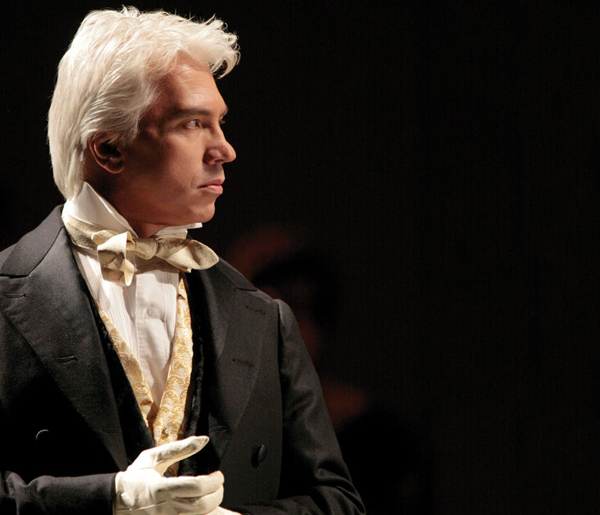
    One of the era’s few true titans of the opera world, Dmitri Hvorostovsky, has passed away at the age of 55. 

    It’s possible I was the first person in the Americas to hear the voice of Dmitri Hvorostovsky. Within a week of his historic Cardiff Singer of the World win in 1989, my dear friend Mollie sent me tapes of the competition – which had produced the famous ‘Battle of the Baritones’ as Dima and Bryn Terfel vied for the top prize. They both won: Hvorostovsky the main title and Bryn took the Lieder Prize; they both went on to spectacular careers.

    His Cardiff win sent the charismatic Russian singer on a career trajectory that took him to the great opera houses and concert stages of the world. He was beloved by audiences everywhere.

    At The Met, Hvorostovsky made his debut in 1995 as Prince Yeletsky in PIQUE-DAME. He went on to sing nearly 200 performances with the Company. I had the good fortune of seeing him often in such roles as Belcore in ELISIR, Germont, Posa, Andrei in WAR & PEACE, Onegin, Renato in BALLO IN MASCHERA, Count di Luna, Simon Boccanegra, Carlo in ERNANI, and Rigoletto.

    In 2015, already in treatment for a brain tumor, Hvorostovsky made a heroic effort to come to New York City to sing three performances as Count di Luna in TROVATORE; the audience greeted him with fervent affection, and he sang beautifully.

    Dima

    Above: fantastic moment as Dima greets fans after his 2015 Count di Luna at The Met.

    In February 2016, I saw Hvorostovsky for what was to be the final time: in recital at Carnegie Hall. On May 7th, 2017, he appeared on The Met stage for the last time: at a gala marking The Met’s 50th season at Lincoln Center, Dima made an unannounced appearance, singing the “Cortigiani!” from RIGOLETTO.

    Scanned Section 2-1

    Three times prior to that last Carnegie recital, I heard Hvorostovsky in concert settings. The first was at Symphony Hall in Boston where, in 1995, he gave an all-Russian program with chorus; as an encore, he sang “America the Beautiful” – gorgeously – and took a high A (or was it a B-flat?) at the climax that was simply thrilling. The entire afternoon was a feast of splendid singing.

    Scanned Section 4-1

    In 1998, soon after I’d moved to New York City, Hvorostovsky sang Mahler’s Kindertotenlieder with the New York Philharmonic. The music suited him to perfection. And in April 2010, he joined soprano Sondra Radvanovsky in a program of arias and duets at Carnegie Hall: two of the truly distinctive artists of our time.

    Looking back:

    6a00d8341c4e3853ef01b8d21a7d3b970c-800wi

    Dmitri Hvorostovsky – BALLO aria – Cardiff 1989

    Dmitri Hvorostovsky – In The Stillness of the Silent Night~Rachmaninoff – Cardiff 1989

    More of The Voice:

    PECHEURS DES PERLES – duet – Paul Groves & Dmitri Hvorostovsky – Tucker Gala 1995

    Hvorostovsky – TROVATORE aria – Tucker Gala 1995

    Dmitri Hvorostovsky & Rene Pape – DON CARLO scene – Met 2006

    Hvorostovsky – arias from PRINCE IGOR and ERNANI – BBC Proms 2006

    As Eugene Onegin:

    Onegin

    Dmitri Hvorostovsky – ONEGIN aria

    Portrait of the artist as a young man:

    1987

    I met Dmitri Hvorostovsky only once, very briefly. I was leaving work at Tower Records as he and his wife were coming in. I spontaneously held out my hand and he grasped it firmly and gave me a smile. Neither of us said a word.

    Dmitri Hvorostovsky – Tchaikovsky ~ None But The Lonely Heart

  • TURANDOT @ The Met

    Turandot0607.07

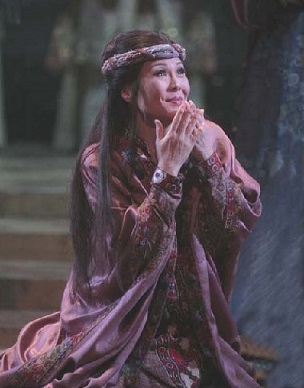
    Above: Hei-Kyung Hong as Liu in a Beatriz Schiller/Met Opera photo

    ~ Author: Oberon

    Thursday November 16th, 2017 – I invited my friend Claudia Schreier to this evening’s performance of TURANDOT at The Met; I wanted her to experience one of last truly grand opera productions in the Met’s repertory. The presence in the cast of Hei-Kyung Hong as Liu was a major factor in choosing this particular evening.

    As at every performance of TURANDOT I’ve attended in the past 30 years, the house was packed. And, as at every Hei-Kyung Hong performance I have attended at The Met, the soprano’s presence in the cast drew large numbers of Asian opera fans. It turned out to be – yet again – Ms. Hong’s night. 

    The evening got off to a sluggish start: Carlo Rizzi’s pacing of the Mandarin’s opening address was slower than the MTA and caused baritone Jeongcheol Cha to dig deep for sufficient breath to sustain the phrases of his proclamation. Later, Rizzi thoughtlessly allowed too much orchestral volume at times, undermining expressive opportunities for his singers.

    23658727_10156216374773690_1557430116954388631_n

    The towering figure of Bulgarian basso Giorgi Kirof as Timur (above, taking a curtain call) came onto the scene; in his Met debut, Mr. Kirof’s looming stature gave Ms. Hong’s petite figure as Liu an almost childlike aspect. The basso – a stalwart of the Sofia National Opera – gave a vocally moving performance, reaching emotional heights in the heartbreak of “Liù…Liù…sorgi! È l’ora chiara d’ogni risveglio!” which literally choked me up.

    Alexey Lavrov was a terrific Ping, with a big, warm sound; his “Ho una casa nell’Honan…” was superbly sung. As his sidekicks Pang and Pong, Tony Stevenson and Eduardo Valdes gave characterful singing. I actually love the scene of the three ministers, which Puccini orchestrated so precisely. As the Emperor Altoum, Ronald Naldi’s voice ‘spoke’ clearly – all the way from Amsterdam Avenue.

    Aleksandrs Antonenko had a fine evening as Calaf. He measures out the voice thoughtfully in Act I, saving up for the arduous singing ahead. But his “Non piangere, Liu” was finely judged, revealing veins of beauty in his powerhouse voice. Throughout the Riddle Scene, the tenor scored with dramatically-lit singing, and joined Oksana Dyka’s Turandot on a firm and sustained high-C at the end of “In questa reggia“. Mr. Antonenko also took – and held – a strong high-C at “No, no, Principessa altera! ti voglio ardente d’amor!

    Mr. Antonenko’s “Nessun dorma” was persuasively sung, reveling in the music’s inherent lyricism; he pulled off the climactic phrase impressively and managed to both acknowledge and forestall a wave of ‘bravos!’ by holding up his hand, letting the opera flow forward. The tenor’s singing in the final duet was first-rate, with some lovely expressions of tenderness as Turandot succumbed to him.

    Oksana Dyka’s voice is slender of tone yet strong of projection. The top range doesn’t blossom but the notes are there; it took a few phrases for the sound to shake loose. As she moved downstage in the course of “In questa reggia” the voice began to speak into the house with increasing effect. Her Riddle Scene was filled with characterful expression: fire and ice. Following her collapse and her desperate plea to her father, the scene turned dramatically absorbing.

    Ms. Dyka, her hair down and nearly prone with despair, is literally overcome with wonderment when Calaf/Antonenko offers her a way out of the bargain. She simply stares at him, realizing that this is a different kind of man than she’s accustomed to dealing with. Then he gently helps her to her feet. The chemistry between the two singers here was genuine; I’ve never seen that moment done quite that way.

    Ms. Dyka’s voice seemed freer in Act III, and she was sustaining the phrases more and reveling in the upper range notes, holding them to generate increased excitement. Her “Del primo pianto” was movingly sung, opening up her humanity which has been bound in ice for so long. In the final moments of the opera, the soprano’s “Padre augusto…Conosco il nome dello straniero! Il suo nome è…Amor!” had a silvery gleam and a prolonged top-B.

    Hei-Kyung Hong’s Liu has captivated audiences time and again in her long Met career. As someone who has seen and heard so many splendid sopranos essay the role of Liu – people like Moffo, Freni and Caballe – I feel Hei-Kyung’s stands at the pinnacle both for her physical perfection and her deeply moving singing.

    If her Wikipedia page is accurate, Hei-Kyung is now 58 years old. Her voice has retained its freshness thanks to her wisdom in choosing repertoire. Tonight both the beauty of her sound and the instinctive rightness of her phrasing gave the music a deeply feminine quality; she also has a feeling for the Italianate style that escapes many non-Italian-born singers. Both her arias were as finely sung as I’ve ever heard them, and her death scene was truly heart-rending. She received a vociferous ovation, very much deserved.  

    All evening, the Met Orchestra made marvelous music, with particular magic from the violin of concertmaster David Chan who made so many of his phrases shine. Likewise, the chorus were at their most fervent and full-voiced.

    Turandot0910.06 sohl

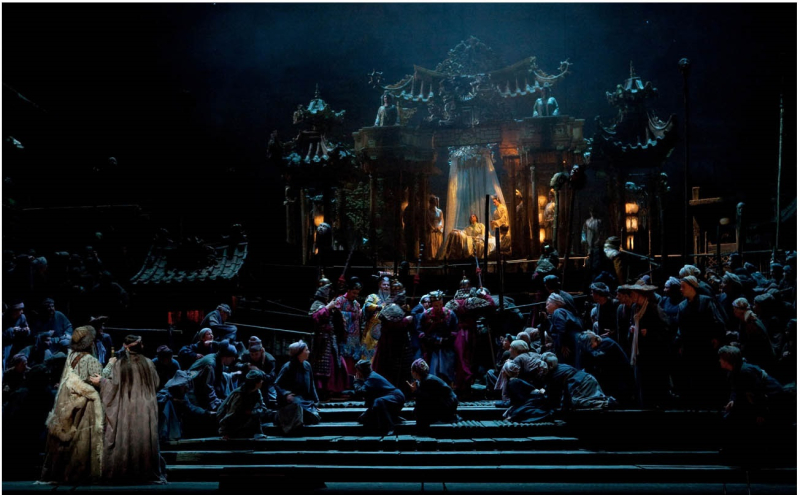
    Above: Act I production photo by Marty Sohl/Met Opera

    Some of the original staging has been altered and to me this weakens the overall effect of the opera. And the crowd scenes seem less crowded than in the past. The 45-minute intermission after the 35-minute first act would have been unbearable had I not had the one-and-only Claudia Schreier to keep me company.

    Catch the curtain calls here, with the charming episode of the “missed bouquet”.

    ~ Oberon

  • David Finckel and Wu Han

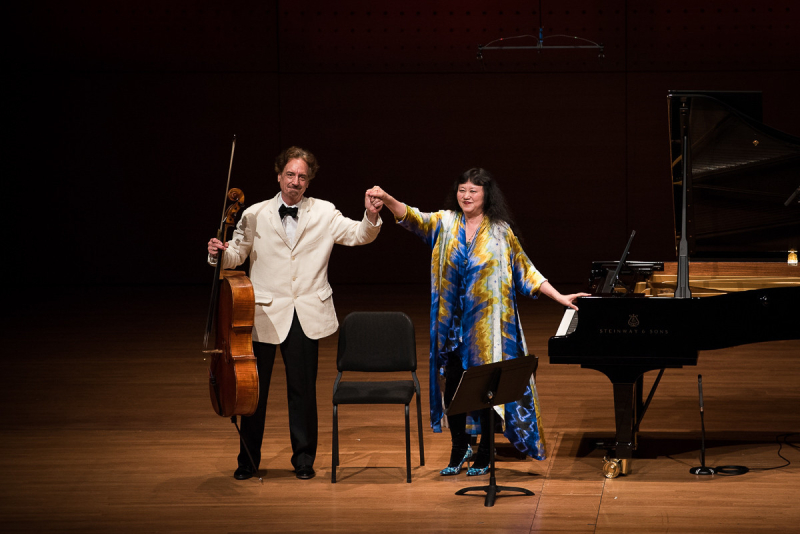
    W_006_ChamberMusicSociety_CherylynnTsushima_20170712

    Above: David Finckel and Wu Han, photo by Cherylynn Tsushima

    Due to the severe wind and rainstorm on Sunday, I had to miss the Chamber Music Society of Lincoln Center‘s program featuring Tamara Mumford and the Escher String Quartet. I was there in spirit.

    I did want to draw everyone’s attention to this wonderful article about Chamber Music’s Society’s co-Artistic Directors, Wu Han and David Finckel. They are two of my favorite players and personalities in the music world, and it’s enlightening (and fun!) to read more about them.

    ~ Oberon

  • Pianist George Li @ Weill Hall

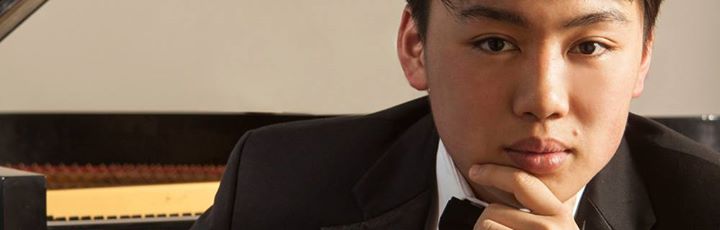
    Li

    Above: George Li

    ~ Author: Oberon

    Friday October 27th, 2017 – I first heard the young Chinese-American pianist George Li when he appeared at the 2015 Young Concert Artists gala; read about his marvelous performance here. Tonight I was glad of an opportunity to hear Mr. Li again, in a solo recital at Weill Hall.

    Small of stature, the 21-year-old pianist is a titan of talent. In a well-devised program this evening, he captivated his large and very attentive audience with playing on the grand scale: and while he is capable of massive volume and of veritable thunderbolts hurled from the keyboard’s lower octaves, Mr. Li also shows expert dynamic control in nuanced phrases and great sensitivity in passages of poetic expression. 

    Mr. Li’s choice of Haydn to open his program proved ideal. In the composer’s B-Minor Sonata (1776), the pianist was able, within moments, to display his broad dynamic range. The opening Allegro moderato alternated subtle turns of phrase with full-bodied, emphatic motifs. The sonata’s Minuet, a simple melody, turns somewhat grander in the trio section; Mr. Li delineated this shift to perfection. In the somewhat rambunctious final Presto, the pianist teased us with charming pauses between scales and trills, tossing off all the coloratura passagework in this unusual and inventive movement with complete clarity.

    The centerpiece of Mr. Li’s program was his interpretation of Chopin’s second sonata, which is built around its famous third movement: the Marche funèbre.

    From its turbulent opening, the opening Grave – Doppio movimento gave us a breathtaking display of the pianist’s gifts. The music is alternately seething and pensive, with a rising theme corresponding to a rise in the player’s passion. My notes on his playing were reduced to “Huge!”, “Thrilling!” and “Epic turmoil!” After a brief display of tenderness, the pianist became so searingly rhapsodic that I simply wrote “DAMN!”. In an electrifying moment, Mr. Li sustained the movement’s concluding chord and then suddenly pulled his hands off the keyboard to his chest. It was a gesture I’ll never forget.

    Following an agitato start and some darkly wild passages, the second movement turns into a slow waltz. Mr. Li wandered beautifully thru this musical landscape, reveling in his dynamic control. After a return to speediness, the music ends on a fading note: more magic.

    The doleful Marche funèbre was poignantly played; we felt the weight of the world upon us in Mr. Li’s deeply mournful phrases. Then a clear, sentimental melody rises from the bleakness. With heartfelt modulations and a caressive softness of touch, the pianist’s playing here was transportive. The march then returns, and gloom settles in once more.

    With a scurrying feeling, the sonata’s concluding Presto seems almost like an afterthought in its brevity. After about a minute, Mr. Li’s nimble hands suddenly hesitate and the sonata ends with a briskly struck chord.

    The Chopin elicited prolonged applause from the audience, and Mr. Li was called back for two bows; he acknowledged our enthusiasm with a lovely hand-over-heart gesture.

    Following a longish interval during which the piano tuner seemed to be performing major surgery on the Steinway, Mr. Li returned with works by Rachmaninoff and Liszt.

    I found Rachmaninoff’s Variations on a Theme of Corelli, written in 1931, to be the least interesting music on the program. The theme itself is nothing to write home about; then Rachmaninoff throws everything but the kitchen sink into the variations. Mr. Li brought all his prodigious gifts to this piece, from the simple setting forth of the theme thru the panoramic rhythms and harmonies of the endless variations. The audience were with him every step of the way, but – for all the delights of his playing – I found myself wishing he had programmed something else.

    Such notions were swept away with Mr. Li’s choices of the concluding works for his recital: ideally contrasted, Franz Liszt’s meditative the Consolation in D-flat Major found its perfect counter-poise in the mad virtuosity of his Hungarian Rhapsody No. 2.

    In the Consolation, the pianist created a dreamlike atmosphere with his delicate, contemplative playing. Then there was a brief silence and Mr. Li launched the Hungarian Rhapsody with its vibrant gypsy themes. Sparkling virtuosity, and a sense of playfulness in his variances of speed and witty pauses, the pianist kept the audience enthralled. The sight of his fingers flying up and down the keyboard at super-speed with mind-boggling.

    Engulfed in waves of heartfelt applause, Mr. Li offered two encores from the operatic repertoire, displaying both his sensitive and his uninhibited sides. In the gentle and simple clarity of the Blessed Spirit theme from Gluck’s ORFEO ED EURIDICE and then in the sexy brilliance of the Chanson bohème from Bizet’s CARMEN, Mr. Li summarized his dual nature: as a poet and a virtuoso.  

    The Program:

    • HAYDN Piano Sonata in B Minor, Hob. XVI: 32
    • CHOPIN Piano Sonata No. 2 in B-flat Minor, Op. 35
    • RACHMANINOFF Variations on a Theme of Corelli
    • LISZT Consolation No. 3 in D-flat Major
    • LISZT Hungarian Rhapsody No. 2 in C-sharp Minor

    ~ Oberon

  • Ensemble Connect @ Weill Hall

    EnsembleConnectBanner

    ~ Author: Scoresby

    Monday October 23rd, 2017 – In Carnegie Hall’s intimate Weill Hall, I attended an eclectic concert of American music performed by Ensemble Connect (formerly Ensemble ACJW). For those that do not know, Ensemble Connect is according to the Carnegie Hall website “a program of Carnegie Hall, The Juilliard School, and the Weill Music Institute in partnership with the New York City Department of Education.”  Each member is a two-year fellow who performs, teaches, and educates mainly (but not exclusively) in NYC. The Carnegie Hall and Paul Hall (at Juilliard) series of performances are always interesting, as the ensemble typically plays adventurous mixes of chamber music repertoire. 

    I was excited to see the program began with the wonderful clarinetist Yonnah Kim and the colorful pianist Lee Dione performing the Bernstein Sonata for Clarinet and Piano. While I had never heard the sonata before, I remembered Ms. Kim from her excellent performance last year in Golijov’s The Dreams and Prayers of Isaac the Blind. The sonata is divided into two movements, the first being having a relatively dissonant skittering melody reminiscent of Hindemith. The second is more in the mode of Bernstein’s popular style, with jazzy sections. I couldn’t help but wonder if Bernstein had been listening to the Rite of Spring when composing the piece, there are a few allusions throughout the sonata. 

    Ms. Kim captured the oscillating clarinet in the first movement part well with a clear, mysterious sound – managing to shade the lower register parts of the work with a dusty timbre. In the second movement, she added flair to the jazzy sections making them come to life. Mr. Lee managed to capture the mood well with subtle dynamic phrasing and finesse in the rhythmic sections. While I can’t say I was fond of the sonata musically, both players sounded as if they had playing together for years.

    After the sonata, Mr. Dione gave a short speech tying together the wide-ranging program; highlighting the need for distinct American voices to be heard. The second piece on the program was Missy Mazzoli’s Still Life with Avalanche, which is for flute (Rosie Gallagher), clarinet doubling as bass clarinet (Yoonah Kim), violin (Adelya Nartadjieva), viola (Andrew Gonzalez), cello (Madeline Fayette), piano (Lee Dione), percussion (Brandon Ilaw), and 3 harmonicas. The work begins with the harmonicas and strings creating an atmospheric drone that is then interrupted by the bass clarinet and piano. These interruptions build and become more frequent until the piece takes shape. It sounds like a mix of a few genres ranging from rock to contemporary classical. The players all gave a committed performance, embracing each different style of music and coordinating well. 

    The last piece on the brief first half of the program was Copland’s Sextet for clarinet (Yoonah Kim), violins (Rebecca Anderson and Adelya Nartadjieva), viola (Andrew Gonzalez), cello (Julia Yang), and piano (Mika Sasaki). The piece is a reduction of Copland’s Short Symphony, though I hadn’t heard either before. The writing is densely packed with complex rhythms, jazzy riffs, and lyrical melodies. It is an excellent piece, though there is almost too much to listen to in the first movement. Despite the difficulty of getting the timing correct on this piece, the ensemble seemed very together capturing the nervous trudging quality of the opening. Balance-wise, it was a pleasure to hear Ms. Yang’s resonant voice, she seemed to capture the bouncing character of the piece well. It keeps its momentum all the way until the first chords of the second movement. There is a dramatic shift to a quiet chorale-like second movement, which slowly builds in intensity. The strings did a good job of providing a resonant sound, contrasting the first movement well. The finale is a more calculated cacophony that really emphasizes jazzy rhythms and slides. Duets between Ms. Kim and the various strings provided a light and entertaining sound.

    The second half of the program was devoted to one of Steve Reich’s most important works: Different Trains. The piece is for a quartet and tape (sound engineer Benjamin Furiga assisting in this performance); the quartet consisting of Adelya Nartadjieva on first violin, Rebecca Anderson on second violin, Andrew Gonzalez on viola, and Madeline Fayette on cello. The tape has tracks of trains, the speech of holocaust survivors from interviews with Mr. Reich, and a taped quartet. The music and the speech imitate each other creating a hybrid between speech and music through the three movements of the piece. While certainly an important milestone in 20th century classical music and a well-crafted composition, I’ve never had an affinity for this piece. It seemed particularly strange to hear such an emotional work about the holocaust and the aftermath of World War II in Weill Hall’s intimate grandiloquent setting with gold trimming and a beautiful chandelier. 

    Nonetheless, the musicians executed the performance well, keeping their place despite the fact that there seemed to be technical issues with the spoken part of the tape (while audible some of the time, it seemed to cut in and out at times making it hard to follow). They all seemed invested in the music and it showed: many audience members around me were bobbing their heads to the hypnotic speech/rhythms. I appreciate that Ensemble Connect goes after diverse sets of repertoire that typically wouldn’t be programmed together, especially when the playing is as high caliber as it was this evening.

    ~ Scoresby

  • Weilerstein|Barnatan @ Zankel Hall

    Barnatan and Weilerstein Photo by Paul Stewart

    Above: Inon Barnatan and Alisa Weilerstein, photo by Paul Stewart

    ~ Author: Scoresby

    Tuesday October 17th,  2017 – In Carnegie’s Zankel Hall, cellist Alisa Weilerstein and pianist Inon Barnatan gave a probing recital exploring a variety of repertoire. I noticed on my way into the building that the performance sold out, the crowd was buzzing with energy before the performance. While I have heard both of these instrumentals as soloists with orchestras before, I had never heard either in recital. Recently the duo has been touring and recording together, so it was easy to see their fluency with each other’s playing.

    The performance began with Mendelssohn Cello Sonata No. 2 in D Major, Op. 58. Immediately striking about the jubilant opening was the amount of restraint that both artists have. Instead, they focused on creating color, mood, and structure rather than the usual busty opening. Particularly satisfying was the clear, crisp phrasing during the recapitulation. Clearly both musicians have technical mastery of their instruments. The second movement begins with an impish scherzo that mixes cello pizzicato with staccato notes on the piano. Here, they both managed to capture the darker coloring well, particularly with Ms. Weilerstein’s dry sound. The music then has a contrasting romantic second theme. 

    Rolling choral-like arpeggios at the start of the third movement were the highlight of this piece. Mr. Barnatan took his time savoring each of these chords, capturing the happiness tinged with nostalgia. It is a pleasure to hear a duo where the instrumentalists have equal command of their instruments. In the fast-paced final movement the interplay between the two musicians was fun to hear, one picking up a scale the other had just finished zipping back and forth. They gave a fast, structured account through the chords.

    Rostropovich_Britten

    Above, from the archives: Rostropovich and Britten

    One of the reasons I was interested in this particular performance was to hear Britten Cello Sonata in C Major, Op. 65. While I know the cello suites, I hadn’t heard this particular piece before. This was the first of a few pieces written for Rostropovich (all within Britten’s later period). It was a pleasure to hear this for the first time, especially with Ms. Weilerstein’s edgier sound. The first movement, “Dialogo: Allegro” is aptly named. It beings almost like an argument between the two instruments, each cutting each other off with jazzy syncopated rhythms. The theme seems both anxious and wistful at the same time. Ms. Weilerstein seemed to emphasize a drier scratchy sound over lyricism, which worked well to contrast Mr. Barnatan’s softer staccato chords. 

    The second movement is a sinewy display of pizzicato for the cello. It is quiet, fast, and virtuosic for both instruments. Both players performed with verve, it was particularly satisfying hearing the quiet bite they both added. The third movement fully flushes out the misty nostalgia of the first movement, bringing the piece to its emotional climax. Ms. Weilerstein captures the dark colours of this movement well, really letting the lower registers shine and letting her sound expand. Her playing is striking because unlike many cellists, she has a pin-point sound that usually feels dry and craggy – it was fabulous hearing her let the cello resonate in this movement. The fourth movement contains many delicious cello shrieks and other effects, the players making the mood restless again. The final fifth movement is a relentless trudge to the end and had the audience give an enthusiastic ovation. I must say that after hearing this very convincing performance, the piece has become one of my favorites for cello and piano.

    S Mackey - Copy

    Above: composer Steven Mackey

    Steven Mackey’s compositions are always a pleasure to hear, he has a creative way of using instruments that makes listening to his works live particularly enjoyable. There are always effects that recordings can’t quite capture, and it is fun to be able to see how they are produced. Through Your Fingers, which had its world premiere with this performance and was co-commissioned by Carnegie Hall, is a one-movement piece that is divided into four distinct sections. I wonder if Mr. Mackey was aware that this piece would be paired with the Britten because stylistically they worked quite well with one before the intermission and one directly after. Mr. Mackey’s piece seems to wander between a few different moods/themes – none of them reach their conclusion, instead continuously switching and developing.

    The first section is slow and lyrical, while the second becomes more agitated with interesting shifting rhythms. I couldn’t help but picture a primordial environment when listening, particularly with the high harmonic theme with the cello. Some of Mr. Mackey’s scales in the piano part reminded me of Ginastera. I can’t imagine a more committed performance of this piece, Mr. Barnatan letting the piano oscillate between a more percussive bass and sweet melodic scales with Ms. Weilerstein embracing all of the extended cello techniques. Both led the piece into its passionate climax, capturing both the wild side of the music while still feeling grounded and precise. 

    While I wouldn’t remove any of the pieces on the program, the second half felt very long coming in at over an hour. The final piece on the program was the classic Rachmaninoff Cello Sonata in G Minor, Op. 19. It was finely played, Mr. Barnatan having a colorful palette and Ms. Weilerstein with her clarity and transparent sound. Mr. Barnatan played the piano part with a Chopin-esque lyricism, never letting the many large chords becoming overwrought. As an encore, they offered the third movement of the Chopin Cello Sonata. Both artists seemed more relaxed after the large program, letting the music flow and letting themselves get swept up a little. The crowd seemed deservedly enthusiastic at the close. 

    ~ Scoresby

  • Bohemia in Bloom @ Chamber Music Society

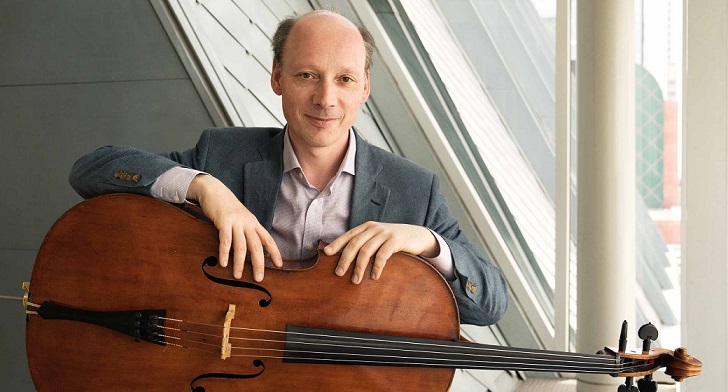
    Clive Greensmith

    Above: cellist Clive Greensmith

    Author: Oberon

    Sunday October 22nd, 2017 – This program offered by Chamber Music Society of Lincoln Center of works by three Czech composers got off to a dazzling start with music by Josef Suk, with whose music I’d had little previous connection. Suk’s Piano Quartet in A minor was his opus #1; he dedicated it to his teacher, Antonin Dvorák.

    Hearing this quartet tonight was an experience I would have described in the 1960s as “mind-blowing”. The Suk also provided us with an introduction to a remarkable cellist, Clive Greensmith. For fourteen years the cellist of the Tokyo String Quartet, Mr. Greensmith is now a chamber/symphonic soloist and a member of the Montrose Trio. As the applause for this evening’s opening Suk quartet commenced, my companion and I turned to one another and said, “The cellist!” We’ll be looking for any opportunity to hear him again.

    Composed in 1891, Josef Suk’s piano quartet simply brims over with glorious melody and rhythmic vitality. He writes beautifully for all four instruments, giving each voice ample opportunity to shine forth. Mr. Greensmith, in his first CMS appearance, found himself in the elite company of some of our favorite CMS personalities.
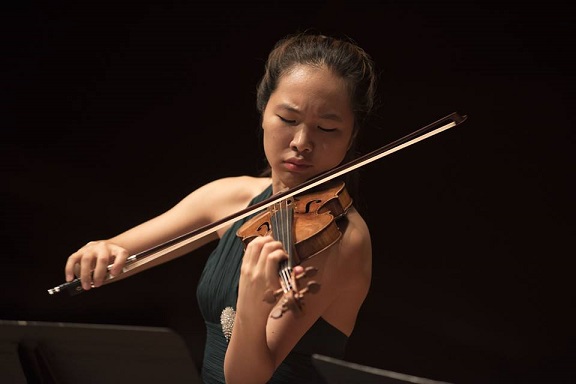
    Danbi

    Above: violinist Danbi Um

    From the very opening, with the strings playing a unison theme from which Danbi Um’s violin takes flight, we are drawn into this music. Gloria Chien at the Steinway brings the tempo down a bit and a flow of melodies commences which will carry us thru the first two movements, evoking spine-tingling sensations thru their heart-on-sleeve beauty. The passion of the music rises and falls, building to grand themes and then subsiding to provide solo opportunities for the players.
    7714943343e43b17749221426c024487-300x200

    Yura Lee (above), always so very welcome among the Society’s many peerless artists, gives her customary dusky glow to the viola passages, and Mr. Greensmith’s cello is thrilling in both its uncanny resonance and immaculate finesse. Playing together in their deeper range, our three string soloists produced a rich texture that gave the impression of a full string orchestra in play. A passage of soul-filling passion brings the first movement to an end.
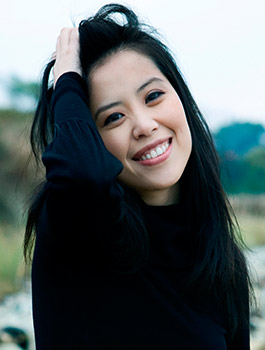
    Gloria-chien

    Above: Gloria Chien

    Extraordinary softness of touch from Gloria Chien’s keyboard lures us into the central Adagio. Then Mr. Greensmith commenced a cello theme of incredible richness: heavenly playing. Ms. Um’s elegant violin sails sweet and high, and then Ms. Lee joins her string colleagues in an assault on the emotions: “These Players!” is all I wrote.

    But Suk, in this Adagio, has still more to offer us: for Mr. Greensmith’s cello again plunges to the depths. By this point I’m literally entranced. Briefly the music seems to sparkle from the piano and high violin, and then a splendidly rhapsodic feeling takes over. Where one might expect this music to finish with a final grand gesture, it instead goes into a long fade-away and vanishes into thin air.

    Ms. Chien is superb in the quartet’s closing Allegro con fuoco, which is at times scherzo-like in feeling. The pianist plays inventive bridges between solo passages for the three string players. An almost militant feeling develops, only to give way to more tender feelings – expressively played by our quartet – before reaching a joyous close. This performance of the Suk will be held high on my list of magical experiences at Chamber Music Society.
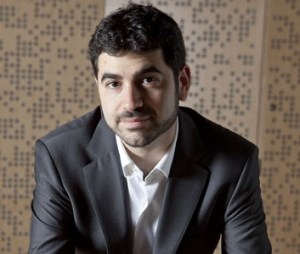
    Michael-Brown-piano

    Above: pianist Michael Brown

    Antonin Dvořák’s first piano quintet, opus 5, was originally performed at Prague in 1872. The composer was not pleased with the work and withdrew it. Fifteen years later, he re-worked the quintet but again was unhappy with it; and so it was that his opus 5 piano quintet was never performed during Dvořák’s lifetime. A manuscript of the 1887 revision was found following World War I and was performed by students at the Prague Conservatory on March 29th, 1922. The score was finally published until 1959.

    Much as I love Dvořák’s music in general, I must say that he was perhaps correct in thinking this particular work doesn’t show him at his best. It’s very attractive music, to be sure, and it goes without saying that it was played to perfection this evening. But somehow it reaches the heart only sporadically.

    Michael Brown at the Steinway opens the quintet, with Mr. Greensmith’s cello passage leading into an appealing violin melody played over a courtly string figure. The tempo slows, then rekindles itself; limpid piano phrases develop into a big tutti finale for the first movement.

    Mr. Brown’s playing was so clear and thoughtful in the sad and somewhat hesitant piano solo that begins the Andante sostenuto. Danbi Um offers an achingly lovely violin solo; the music gets dense and then Danbi and Clive Greensmith trade phrases…like silk and velvet respectively. Mr. Brown’s playing here is truly exquisite, and Ms. Lee took every opportunity to let her viola sound forth. Ms. Um’s violin makes a soft ascent to a quiet ending.

    The final movement begins agitato, with Mr. Brown running off a jaunty piano bit before all join in. The piano is in fact quite prominent throughout this Allegro con brio: from a quaint tune to an almost “toy” piano moment, Mr. Brown has it all superbly in hand. Thru numerous modulations, the music reaches an ebullient end.
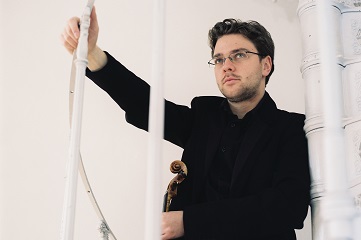
    As2

    Above: violinist Alexander Sitkovetsky

    Following the interval, Alexander Sitkovetsky took the lead in the Smetana G-minor Piano Trio, the opening passages of which provided a perfect showcase for the violinist’s passionate playing. Mr. Greensmith introduces a somewhat sunnier theme, and Mr. Sitkovetsky’s violin soars to the heights. Pulsing energy and a big sweep give way to another flight from the violin. Things get rather turbulent, calmed by Ms. Chien’s fluent piano solo. A grandiose buildup collapses into a swift end.

    The second movement starts out quiet yet lively, with a unison passage. A violin interlude, played lovingly by Mr. Sitkovetsky, is lyrical; then the music turns weightier, with a slow, almost trudging beat. A dancelike feeling emerges, and moves on to an unexpectedly sudden finish.

    The Presto finale opens in a state of near madness, quite a scrambling feeling. Ms. Chien’s piano has a sense of urgency, then she plays single notes in succession to mark a quietening. An affecting cello theme is taken up by the violin. Lovely melodies, over rippling piano figures, vanish in another burst of forward motion; then the tender cello theme is heard once again, with the piano blending, and a really fine, pensive solo bit from the Steinway. The strings sing out, only to give way to a dirge-like passage. But the music rebounds with vitality, Mr. Sitkovetsky’s violin rising in triumph. All seems about to end well, but Smetana briefly lets a cloud creep by before it’s dispelled by a brisk three-bar fortissimo.

    After joining in the standing ovation that greeted the players at the end, my friend Adi and I found ourselves discussing yet again how fulfilling these CMS concerts are, and how wonderful the music always sounds in Alice Tully’s house.

    The Repertory: 

    • Suk Quartet in A minor for Piano, Violin, Viola, and Cello, Op. 1 (1891)
    • Dvořák Quintet in A major for Piano, Two Violins, Viola, and Cello, Op. 5 (1872)
    • Smetana Trio in G minor for Piano, Violin, and Cello, Op. 15 (1855, rev. 1857)

    ~ Oberon