Category: Opera

  • TROVATORE @ The Met

    D H

    Above: Dmitri Hvorostovsky

    Tuesday September 29th, 2015 – Having cancelled most of his Summer engagements to commence treatment following the diagnosis of a brain tumor, the great Russian baritone Dmitri Hvorostovsky valiantly came to New York City to sing for us at The Metropolitan Opera. The necessity of returning to London to continue his treatment regimen meant that the baritone would only sing the first three of his scheduled Met performances as Count di Luna in IL TROVATORE, but to me it spoke highly of his dedication that he made the effort to come in for these high-profile performances which also feature the first Met Leonoras of Anna Netrebko.

    At the season prima, on September 25th, the audience greeted Hvorostovsky’s entrance with a show-stopping ovation. The evening ended with a tumult of cheers and applause as he took his bows, and the members of The Met orchestra flung flowers up onto the stage, signalling their affectionate regard for the great singer.

    And a great singer he is…truly. Tonight – the second of the three performances in which he’ll appear – Hvorostovsky was again given a prolonged round of applause at his entrance. To me, his voice sounded, amazingly, more beautiful than ever. “Il balen” was the vocal high-point of the evening: superbly phrased and deeply felt, sustaining the poetic musings of a character often described as “evil” but who is, essentially, a real romantic. 

    Hvorostovsky’s Count di Luna in fact manages to engage our empathy when he is cruelly beaten by Manrico’s men in the convent scene; Manrico slashes his rival’s face, and Hvorostovsky’s acting here was wonderfully committed. All evening, the baritone kept the character very much in the forefront of both the music and the drama, from with his snarling “Io fremo!” as he listens to Manrico serenading Leonora in Act I right to the end where – if my ears didn’t deceive me – Dima chimed in on Azucena’s final high B-flat with one of his own. 

    Dolora Zajick’s Azucena was thrilling from start to finish; the esteemed mezzo-soprano flung her fiery high notes and cavernous chest tones into the house with resplendent authority, her monologue  “Condotta ell’era in ceppi” a veritable whirlwind of emotion as she displayed an uncanny dynamic range from haunting near-whispers to thunderous outbursts. This evening she didn’t take the high-C in  “Perigliarti ancor languente” that had been one of her trademarks in this role, but instead swept onward like an force of nature. Her expressive singing of “Giorni poveri vivea…” was counter-balanced moments later with the sweeping anguish of “Deh! rallentate, o barbari!” which commenced on a lightning-bolt top note and plunged into vivid chest notes. In the opera’s final scene, Zajick displayed marvelous control in “Ai nostri monti” and in the trio where she seems to be singing in her sleep, only to awaken to the horror of Manrico’s execution. Her triumphant B-flat was a glorious cry of revenge achieved. 

    The Korean tenor Yonghoon Lee made a positive impression as Manrico, despite the fact that his voice is rather lighter than we are accustomed to in this music. In fact, Lee’s entire repertoire seems geared to roles which call for more vocal heft than he seems capable of: I wonder if he might not be better employed – at least for now – as Alfredo, the Duke of Mantua, and Tamino.

    But there’s no going back, and Lee’s impassioned commitment to both the music and the character of Manrico had the audience well engaged. Lee’s slender figure and intense acting gave the rebel leader a romantic, swashbuckling appeal; and his mixture of unbridled vocal passion with moments of hushed piano reflectiveness kept the music aurally stimulating. Oddly, he sometimes reminded me of Franco Corelli – not in terms of the voice itself, but with the smouldering ardor of his delivery. 

    Lee sang a beautifully modulated, emotional “Ah si, ben mio” and – if I am not mistaken – took “Di quella pira” in C with an endlessly sustained final note which was ever-so-slightly below pitch. The audience took the tenor to heart, and Mr. Lee was very warmly applauded at the curtain calls.

    Anna Netrebko seemed to be forcing her voice in some of Leonora’s music; in pushing for a larger, darker sound, some of the inherent lyric beauty of her tone is drained away. Her over-leaning into the chest register was a detriment: this isn’t Santuzza. There were many fine passages along the way, but also some errant pitch and some glare on the louder high notes (she skipped the D-flat at the end of the Act I trio). The audience, needless to say, adored her.

    Stefan Kocan was a powerfully-sung and dramatically commanding Ferrando, with Maria Zifchak a big-voiced Inez and my friend Edward Albert in the brief role of A Gypsy. Marco Armiliato’s conducting was ‘good routine’ – and better than that after the interval – and the orchestra played very well.   

    A program note explained that Ms. Netrebko’s costumes had been specially created for her. Her breasts were amply on display in the opening scene’s burgundy outfit, then at the convent she was all buttoned up, a prim and proper young ‘widow’ in black. She went in for a gypsy look for the scene prior to her (thwarted) marriage, with a nifty head-wrap.

    For all the passing “ifs, ands, or buts”, this was overall a pretty exciting night at the opera: there was involvement, passion, and some very impressive vocalism along the way.

    Metropolitan Opera House
    September 29th, 2015

    IL TROVATORE
    Giuseppe Verdi

    Manrico.................Yonghoon Lee
    Leonora.................Anna Netrebko
    Count Di Luna...........Dmitri Hvorostovsky
    Azucena.................Dolora Zajick
    Ferrando................Stefan Kocán
    Ines....................Maria Zifchak
    Ruiz....................Raúl Melo
    Messenger...............David Lowe
    Gypsy...................Edward Albert

    Conductor...............Marco Armiliato

  • NY Philharmonic Welcomes A New Concertmaster

    Frank-huang

    Above: Frank Huang

    Friday September 25th, 2015 – The New York Philharmonic‘s opening concert of the subscription season introduced us to the orchestra’s new concertmaster, Frank Huang. We’d actually seen Mr. Huang playing – unannounced – at a couple of concerts last season; but now it’s official, and the Philharmonic faithful gave the violinist a warm welcome. 

    The program opened with LA Variations, a 1996 work by the Philharmonic’s new Marie-Josée Kravis composer-in-residence, Esa-Pekka Salonen. Salonen’s violin concerto, to which Peter Martins set his 2010 ballet MIRAGE and which the Philharmonic performed in 2013 – is to me one of the outstanding musical works of the 21st century to date. And so I was very curious to hear the composer’s much earlier work this evening.

    Mr. Salonen appeared onstage prior to the playing of the Variations and made an overly-long, rambling speech about how the work was a turning point in his musical thinking. As he talked on and on, audience members around us seemed increasingly restless, and a few dozed off. At last he ambled offstage and Masetro Gilbert took the podium and – as it should – the music spoke for itself.

    LA Variations is a work of consummate craftsmanship and has many very appealing passages; early on, some of the textures reminded me – oddly enough – of the Sea Interludes from Britten’s Peter Grimes. Later there are some big tutti passages that evoke a restless, rocking feeling. At the very end, there was a tantalizing ‘calling card’ from Frank Huang in an entrancing solo passage that whetted the appetite for the Strauss to come.

    LA Variations seemed to show – as he indicated in his speech – the composer’s turning away from the rather sterile musical language in which he had been ingrained (he frequently mentioned Pierre Boulez in this regard), and the planting of the first seeds in his own musical garden; works like the Violin Concerto show us how that garden has bloomed and thrived in the years since Salonen’s 1996 self-discovery.

    Following the interval, we experienced an incandescent performance of Richard Strauss’s Ein Heldenleben (A Hero’s Life), which dates from 1898.

    In December 2013, my friend Dmitry and I experienced a superb rendering of this work played by the Philhamonic under the baton of a conductor me greatly admired: Rafael Frühbeck de Burgos; alas, just six months after that vibrant evening, the venerable Maestro passed away.

    Tonight’s performance found Maestro Gilbert and the Philharmonic artists at their luminous best. It was an uplifting and wonderfully satisfying traversal of this impressive, melodically rich score. Maestro Gilbert favored a forward impetus to the music – very exhilarating – yet also provided the necessary passages of reverie.

    The musical themes continually sound like previews of Strauss’s operas to come – most especially of Rosenkavalier and Frau ohne Schatten, both of which lay many years in the future. The Philharmonic musicians seemed to relish every moment of the score, whether in the big ensemble moments or the many solo opportunities which the composer provides. Philip Myers and his fellow hornsmen were having a grand night of it, as were the trumpeters in their offstage calls. The principal wind players  shone with evocative lustre in their solos. 

    Ein Heldenleben provided an ideal showcase for Frank Huang as he embarked on his Philharmonic journey: in this Strauss work with its marvelous passages for violin solo, Mr Huang’s tone was ravishing and his style so cordial and elegant, always imparting an emotional resonance. I cannot wait for his concerto debut with the orchestra, which I hope will come soon.

    And so, the Summer of my discontent has passed: the season has begun and I look forward to many nights of music and dance to elevate the spirit.
  • TURANDOT at The Met – 1st of 4

    Turandot-Met

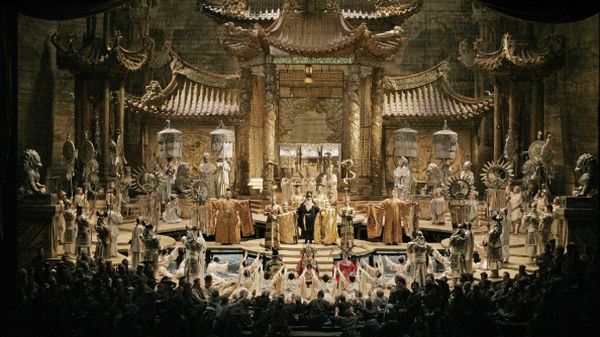
    Wednesday September 23rd, 2015 – At a score desk this evening for the prima of TURANDOT at The Met; I’ll be attending a performance by each of this season’s four Turandots.

    The first act of tonight’s performance was stunning; the conductor, Paolo Carignani, molded the huge choral and orchestral forces into a vibrant sound tapestry and his reading of the score was dynamic, whilst also allowing the necessary moments of poetry to shine thru.

    Patrick Carfizzi got the evening off to an excellent start with his authoritative declamation of the Mandarin’s decree. Hibla Gerzmava’s full-bodied lyric soprano sounded luxuriant in Liu’s music; although she did not go in for the many piano/pianissimo effects that some singers have brought to this music – Gerzmava ended “Signore ascolta” with a crescendo on the final B-flat rather than a tapering of the tone – her gleaming sound was a welcome element to the performance. Marcelo Alvarez as the Unknown Prince sang with appealing lyricism, pacing himself wisely for the vocal rigors which lay ahead. James Morris was an affecting Timur, drawing upon his long operatic experience to create a touching vocal characterization of the old king. Dwayne Croft, Tony Stevenson, and Eduardo Valdes were a first-rate trio of court ministers.

    As the first act ended, I felt the old elation of being at the opera. But the ‘Gelb-intermission’ which followed totally destroyed the impetus of the evening. As is so often the case at The Met these days, the interval stretched to 40 minutes, the last ten of which found the entire audience back in their seats and raring to go while the musicians sat in the pit doodling idly.

    At last the conductor re-appeared and we had a delightful rendering of the Ping-Pang-Pong scene with Mr. Croft and his two tenor sidekicks successfully mining both the wit and the nostalgia of the music, one of Puccini’s most delectable creations – and superbly orchestrated into the bargain.

    I was looking forward to hearing Ronald Naldi – a long-time favorite of mine – as the Emperor Altoum but he was replaced by Mark Schowalter, who projected well from his distant throne. The exchange between the aged monarch and the Unknown Prince was interesting in that Mr. Alvarez eschewed the usual stentorian delivery of “Figlio del cielo…” (three times) for a more pensive vocal quality.

    Christine Goerke’s Turandot did not make the vocal impression I was hoping for; the uppermost notes in the princess’s treacherous music seemed slightly out of Goerke’s comfort zone. She managed well enough, and used a darkish middle and lower range to good effect. But the trumpeting brilliance of the tones above A, which we have come to expect from our Turandots, was not really forthcoming. I am not sure why she wished to sing this role, since Wagner and Strauss are now her natural habitat. 

    Faced with yet another stupor-inducing intermission, I left during the Act II curtain calls. 

    Metropolitan Opera House
    September 23rd, 2015

    TURANDOT
    Giacomo Puccini

    Turandot................Christine Goerke
    Calàf...................Marcelo Álvarez
    Liù.....................Hibla Gerzmava
    Timur...................James Morris
    Ping....................Dwayne Croft
    Pang....................Tony Stevenson
    Pong....................Eduardo Valdes
    Emperor Altoum..........Ronald Naldi
    Mandarin................Patrick Carfizzi
    Maid....................Anne Nonnemacher
    Maid....................Mary Hughes
    Prince of Persia........Sasha Semin
    Executioner.............Arthur Lazalde
    Three Masks: Elliott Reiland [Debut], Andrew Robinson, Amir Levy
    Temptresses: Jennifer Cadden, Oriada Islami Prifti, Rachel Schuette, Sarah Weber-Gallo

    Conductor...............Paolo Carignani

  • TURANDOT at The Met – 1st of 4

    Turandot-Met

    Wednesday September 23rd, 2015 – At a score desk this evening for the prima of TURANDOT at The Met; I’ll be attending a performance by each of this season’s four Turandots.

    The first act of tonight’s performance was stunning; the conductor, Paolo Carignani, molded the huge choral and orchestral forces into a vibrant sound tapestry and his reading of the score was dynamic, whilst also allowing the necessary moments of poetry to shine thru.

    Patrick Carfizzi got the evening off to an excellent start with his authoritative declamation of the Mandarin’s decree. Hibla Gerzmava’s full-bodied lyric soprano sounded luxuriant in Liu’s music; although she did not go in for the many piano/pianissimo effects that some singers have brought to this music – Gerzmava ended “Signore ascolta” with a crescendo on the final B-flat rather than a tapering of the tone – her gleaming sound was a welcome element to the performance. Marcelo Alvarez as the Unknown Prince sang with appealing lyricism, pacing himself wisely for the vocal rigors which lay ahead. James Morris was an affecting Timur, drawing upon his long operatic experience to create a touching vocal characterization of the old king. Dwayne Croft, Tony Stevenson, and Eduardo Valdes were a first-rate trio of court ministers.

    As the first act ended, I felt the old elation of being at the opera. But the ‘Gelb-intermission’ which followed totally destroyed the impetus of the evening. As is so often the case at The Met these days, the interval stretched to 40 minutes, the last ten of which found the entire audience back in their seats and raring to go while the musicians sat in the pit doodling idly.

    At last the conductor re-appeared and we had a delightful rendering of the Ping-Pang-Pong scene with Mr. Croft and his two tenor sidekicks successfully mining both the wit and the nostalgia of the music, one of Puccini’s most delectable creations – and superbly orchestrated into the bargain.

    I was looking forward to hearing Ronald Naldi – a long-time favorite of mine – as the Emperor Altoum but he was replaced by Mark Schowalter, who projected well from his distant throne. The exchange between the aged monarch and the Unknown Prince was interesting in that Mr. Alvarez eschewed the usual stentorian delivery of “Figlio del cielo…” (three times) for a more pensive vocal quality.

    Christine Goerke’s Turandot did not make the vocal impression I was hoping for; the uppermost notes in the princess’s treacherous music seemed slightly out of Goerke’s comfort zone. She managed well enough, and used a darkish middle and lower range to good effect. But the trumpeting brilliance of the tones above A, which we have come to expect from our Turandots, was not really forthcoming. I am not sure why she wished to sing this role, since Wagner and Strauss are now her natural habitat. 

    Faced with yet another stupor-inducing intermission, I left during the Act II curtain calls. 

    Metropolitan Opera House
    September 23rd, 2015

    TURANDOT
    Giacomo Puccini

    Turandot................Christine Goerke
    Calàf...................Marcelo Álvarez
    Liù.....................Hibla Gerzmava
    Timur...................James Morris
    Ping....................Dwayne Croft
    Pang....................Tony Stevenson
    Pong....................Eduardo Valdes
    Emperor Altoum..........Ronald Naldi
    Mandarin................Patrick Carfizzi
    Maid....................Anne Nonnemacher
    Maid....................Mary Hughes
    Prince of Persia........Sasha Semin
    Executioner.............Arthur Lazalde
    Three Masks: Elliott Reiland [Debut], Andrew Robinson, Amir Levy
    Temptresses: Jennifer Cadden, Oriada Islami Prifti, Rachel Schuette, Sarah Weber-Gallo

    Conductor...............Paolo Carignani

  • Mariana Paunova

    Paunova_1

    The Bulgarian mezzo-soprano Mariana Paunova (above) made her operatic debut in 1977, as Pauline in PIQUE-DAME at the Spoleto Festival in Charleston, South Carolina. I saw her as Isaura in a concert performance of Rossini’s TANCREDI at Carnegie Hall in 1978, and she sang at the Met in 1979, as Olga in EUGENE ONEGIN.

    In 1983 I heard her as Laura in a broadcast of LA GIOCONDA from San Francisco and was very much taken with her darkish, plushy sound. In that same year, she recorded Dukas’ ARIANE ET BARBE-BLEUE for Erato, conducted by Armin Jordan.

    Paunova’s career continued apace in the US, Canada, Mexico, and Europe; she sang the role of La Comandante in Riccardo Zandonai’s I CAVALIERI DI EKEBU at Alice Tully Hall in 2000.

    Mariana Paunova taught at the Manhattan School of Music until her untimely death in 2002.

    GIOCONDA – Act II exc – M Paunova – Slatinaru – Bonisolli – Manuguerra – San F 1983

  • The Turandots

    Turandot

    During the coming season at the Metropolitan Opera, I’ll be hearing four different sopranos in the role of Turandot. Of these, three will be new to me in the role: Christine Goerke, Jennifer Wilson, and Nina Stemme. The fourth will be Lise Lindstrom, who made a very fine vocal impression as Turandot here during the 2009-2010 season and who has the added appeal of being wonderfully suited to the role in terms of physique and stage savvy.

    For opera lovers of my generation, the silver-trumpet voice of the great Swedish soprano Birgit Nilsson is unforgettably linked to the music of Turandot; I had the good fortune of seeing Nilsson’s Turandot five times – each performance with a different soprano portraying Liu: Teresa Stratas, Anna Moffo, Mirella Freni, Montserrat Caballe, and Gabriella Tucci. Once you experienced the Nilsson sound in this role in the theatre, you felt you’d never find her equal. 

    And yet, Nilsson was not my first Turandot: it was instead Mary Curtis-Verna who made a very strong impression on this young opera-lover in a performance at the Old Met with Jess Thomas (Calaf) and Lucine Amara (Liu) also in the cast. Curtis-Verna had the Italian style down pat, and she had no problems whatsoever leaping over the many vocal hurdles Puccini set in her path; her final high B-flat had a theatre-filling glow.

    Nilsson (who we referred to as “The Big B” or “The Great White Goddess”) was at her vocal apex in 1966 when she sang a series of Turandots starting in the first week of the first season at the New Met. It’s impossible to describe the exhilarating build-up of anticipation as we waited for her to commence: “In questa reggia”. No recording of Nilsson in this opera, whether studio-made or live, has quite captured the frisson of her brilliant attack and the sheer thrust of the voice being deployed into the big space. Her partnership with Franco Corelli in this opera is legendary; and I was also there on a single night when the stars aligned and we had a Birgit Nilsson-James King-Montserrat Caballe TURANDOT which ended with one of the longest ovations I every experienced. 

    Nilsson sang her last Met Turandot in 1970. When the opera returned to the Met repertory in 1974, Nilsson’s good friend, the Norwegian soprano Ingrid Bjoner was one of three sopranos cast in the title-role. Bjoner for me was the ‘next best thing’ to Nilsson, and to my mind it seemed that Bjoner’s characterization was more detailed and thoughtful than Birgit’s.

    Since Bjoner, I have seen more than two dozen sopranos in the fearsome role of the Chinese princess, at The Met, New York City Opera, and Opera Company of Boston (where we saw Eva Marton take on the role for the first time with great success). Linda Kelm at New York City Opera and Dame Gwyneth Jones at The Met stand out in my memory as particularly thrilling, though I must admit in all honesty I never heard anyone give a less-than-respectable performance in the role – which is saying something, really, given the rigors of the composer’s demands and with the spirit of Nilsson hovering over the popolo di Pekino.

    I have my notions as to how this season’s Turandots will fare, based on their recent performances; I look forward to being proved right…or wrong.

  • Leo Goeke

    Leo-Goeke

    During the 1970s, the American lyric tenor Leo Goeke (above) was a popular artist at both the New York City Opera and The Met. A finalist in the 1967 Met Auditions, Goeke sang more than 200 performances at The Met and on tour, including such roles as Tamino, Count Almaviva, and the Italian Singer in ROSENKAVALIER. He sang (beautifully) the Voice of the Young Sailor in the Met’s 1971 August Everding production of TRISTAN UND ISOLDE, and in 1973 he was Hylas in the Metropolitan Opera premiere of Berlioz LES TROYENS.

    Several of Leo Goeke’s numerous European successes are available on DVD: from England’s Glyndebourne Festival where he sang three Mozart roles and – in 1975 – Stravinsky’s Tom Rakewell in an interpretation that was hailed as ideal; and his performance as Gandhi in Achim Freyer’s Stuttgart Opera production of Glass’s SATYAGRAHA.

    Goeke passed away in 2012.

    Leo Goeke – Il mio tesoro – DON GIOVANNI – NYCO 10~29~72

  • Camellia Johnson Has Passed Away

    C johnson

    News of the death of Camellia Johnson (above) eerily came on a day I had just been listening to her voice. In the course of my Summer project of transferring some of the rare items in my cassette collection to MP3, I had just come across a tape of parts of the Verdi REQUIEM in which Ms. Johnson is the soprano soloist. 

    The broadcast of this REQUIEM was something I came upon quite by chance; as the announcer was introducing the performance, I found myself with only one blank side of one tape to hand. I slipped it into the deck and decided to concentrate on recording excerpts in which the two women are prominent, Florence Quivar being a particular favorite of mine. Listen to what I preserved here:

    Verdi REQUIEM – excerpts – Baltimore 1994 – C Johnson Quivar Heppner G Relyea – Zinman

    In 1995, I had the good fortune to hear Camellia Johnson live at two different, wonderful venues. She sang with the Philharmonia Virtuosi at the Met Museum, and she gave a recital at Alice Tully Hall accompanied by Neal Goren. I remember being blown away by both the velvety warmth of her tone and her gift for finding a direct communicative channel to the audience. On both evenings she programmed Wagner’s Wesendonck lieder; at the Met concert, she gave a stunning performance of “To This We’ve Come” from Menotti’s THE CONSUL whilst with Mr. Goren she sang a lushly resonant “Du bist der lenz” from DIE WALKURE.  

    Camellia Johnson sang at The Met from 1985 thru 1994, debuting there as Lily in PORGY AND BESS. Her most frequent Met role was the Priestess in AIDA; she also scored a personal success with her sumptuous and emotionally charged singing of Madelon’s aria in ANDREA CHENIER.

  • “Questo lido è a lei funesto!”

    L D

    As Laura Adorno and La Gioconda respectively, mezzo-soprano Luciana D’Intino (above) and soprano Eva Urbanová duke it out aboard Enzo’s ship, the Hecate, in this famous scene from Act II of Ponchielli’s LA GIOCONDA. From one of my favorite Italian operas, this excerpt begins with Laura’s prayer “Stella del marinar” and goes on to the fiery duet of the two rivals, “L’amo come il fulgor del creato!”

    GIOCONDA Act II exc Urbanova D’Intino Scala 1996

    Eva U

    Above: Eva Urbanová…the Czech soprano has had a substantial operatic career, and also has a following as a pop and rock singer. She sang at The Met from 1998-2004 where I saw her striking debut performance as Ortrud and also had the good fortune to experience her only Met Tosca, a portrayal that was enhanced by her detailed characterization as well as some surprisingly nuanced singing.

    Luciana D’Intino’s Met career to date has consisted of two appearances each in the “big three” Verdi mezzo roles: Eboli, Amneris, and Azucena. I saw her in all three operas and her performances were astounding in their vocal richness and as marvelous examples of what is now the fast-fading authentic Verdi style.

  • Hina Spani

    Hqdefault

    The Argentine soprano Hina Spani (above) sings “In quelle trine morbide” from Puccini’s MANON LESCAUT.

    Spani’s career was centered in Italy – at La Scala and other major opera houses – and in Buenos Aires. Between 1915 and 1940, she performed over seventy operatic roles. 

    On December 3rd, 1924, at Toscanini’s request, Hina Spani sang at Puccini’s funeral in Milan.